Songs: of the Powwow
[Note: this page was migrated from the Schitsu’umsh - Coeur d’Alene Indians module]
Chel chs tu's swinsh, "we are going over there to war dance"
The singing, drumming and dancing of the powwow provide opportunities for the Schitsu’umsh to express prayer and give thanks, renew family ties and initiate new friendships, and “just have fun.” Held throughout the year, powwows celebrate the gathering of the water potato, the school graduation of the youth, an elder’s birthday, the veterans from the community, a Catholic pilgrimage to the Cataldo Mission, the success of the tribal casino, the ownership of a Lake, and just a “time to gather the families.”
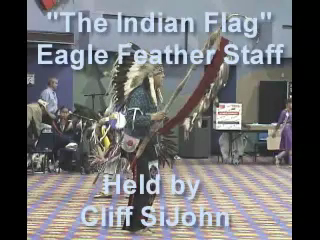
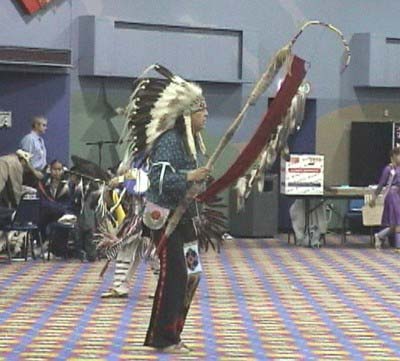
Cliff SiJohn holds "The Indian Flag," the Eagle Feather staff, during the Powwow celebrating the ownership of Lake Coeur d'Alene and the opening of the new tribal Longhouse. The powwow was held at the Coeur d'Alene Tribal Casino on October 20, 2001. (recorded and edited by Rodney Frey, October 2001)
After years of litigation with the state of Idaho, the U.S. Supreme Court ruled on June 18, 2001 that the Coeur d’Alene Tribe was “entitled to exclusive use, occupancy and right” to the bed and banks of the southern third of Lake Coeur d’Alene. On October 20, 2001 the Schitsu’umsh gathered to celebrate the return of their lake. At sunrise of that day many Schitsu’usmh gathered along the shores of the lake to offer prayer and thanks. Then that evening at the Coeur d’Alene Casino the thanks and celebration were continued with the sharing of a meal, followed with the song and dance of a powwow.
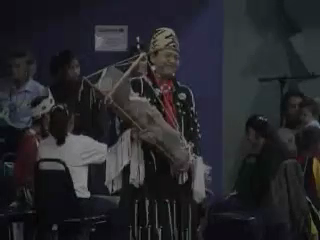
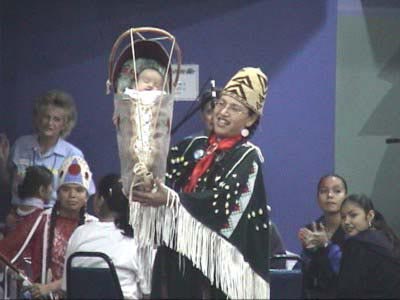
Honoring the Youngest tribal member, Isaac Redheart SiJohn, with mother, Leanne SiJohn, during the Lake Celebration Powwow. Drum: Rose Creek Singers, an all Coeur d'Alene women's drum group. (recorded and edited by Rodney Frey, October 2001)
The “powwow” has emerged in the twentieth century as one of the most vital expressions and celebrations of what it means to be Indian and Schitsu’umsh today. Gathering together and dancing in celebration, in thanksgiving, in prayer, in honoring others and in recreation have always been an important aspect of the life of the people. Following the establishment of the Catholic Church, these various dances were either greatly curtained or outright prohibited. After experiencing the devastation of repeated smallpox epidemics, the trauma at the hands of repressive missionaries, army colonels, and government agents, and dislocation from the land itself as a result of the Allotment Act, today it is in the powwow dance arena that a truly Indian “land” is brought forth and traveled. There are few other places untrammeled by the harsh consequences of the suuyapi. While no longer able to ride against the army colonels of the nineteenth century, the powwow “battlefield” offers an opportunity to successfully resist the onslaught of Euro-American culture.
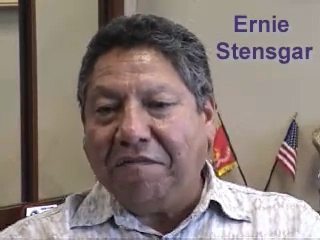
Ernie Stensgar, Tribal Chairman and Vietnam Veteran, reflects on the importance of patriotism, the American and Eagle Staff Flags, and the warrior society. For the Indian veterans, you can still "see the lumps in their throats and tears in their eyes" when they hear the Honor Song, our national anthem. (interviewed and edited by Rodney Frey, September 2002)
Powwow “land” is literally brought into being, at that very moment and at that very place, as the songs are sung and feet move to the rhythm of the drum beat, and as the eagle feather bustles lift the dancers off the ground and swirl them around. In powwow land, be it under the stars in a brush arbor or under the fluorescent lights in a community center, school gymnasium or even a casino, the hearts of young and old are renewed as they are brought into kinship with the heartbeat of the drum. In powwow land the values held dear to one’s family and the unique heritage of one’s people can be celebrated unencumbered. In powwow land sovereignty is fully realized as one is able to rejoice and share what is most cherished and revered - what it means to be Schitsu’umsh.
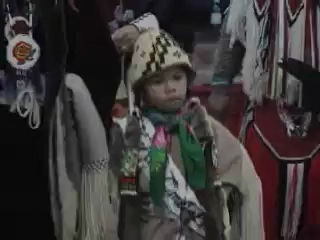
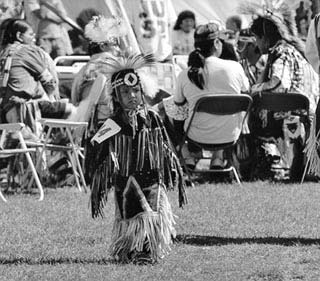
Some of the sights and sounds of Intertribal dances, during the Lake Celebration Powwow, held at the Coeur d'Alene Tribal Casino. Among the dancers are Marcy Morris, Jeanne Givens, Leanne and Frenchy SiJohn, and Father Thomas Connelly (recorded and edited by Rodney Frey, October 2001)
Images
Etiquette
If you are a first time powwow visitor, learn about some basic powwow etiquette on the following pages. It will enhance you appreciation and enjoyment of the powwow.
The song, dance, and regalia of the powwow bring people together in the renewal, as well as the creation of family and friendship ties. By observing basic etiquette and respect, an evening’s participation at a powwow can be so much more rewarding and the hands of friendship extended. If you don’t know something or have a question, ask someone. Start up a conversation with a dancer, a singer, or a vendor. Enjoy yourself!
Showing Respect
- Listen and Observe. You’ll hear the emcee (master of ceremonies) over the sound system. It’s his responsibility to coordinate the powwow, as well as advise the visitors of proper etiquette. He will also share stories and often some “powwow humor.” Listen closely. In addition, for many singers and dancers, the songs are a form of “ceremony and prayer.” It would be impolite to get up from your seat and walk off in the middle of a song; wait until the conclusion of a particular song before go for your fry bread. Non-Indians are always welcome at powwows, to learn and share in the cultural and social traditions. But visitors are also expected to show respect.
- A Dancer’s Regalia is not his or her “Costume”. A dancer’s regalia is carefully handcrafted, with considerable thought, time, energy and expense going into its making. Part of it likely includes family heirlooms. The eagle feathers which adorn most regalia are particularly sacred and must be cared for properly. Never touch a dancer’s regalia. Its not in any way comparable to a “Halloween costume!”
- Show Courtesy and Respect when using your still or video Camera and your Tape Recorder. During most of the public events of a powwow, pictures can be taken of the dancing. This is especially acceptable during the intertribal or dance competitions. The emcee will generally let you know when it will be absolutely not acceptable to take photographs. However, when taking a picture of an individual dancer, it is common courtesy to always introduce yourself and ask permission before you take a picture. And ask for his or her address so you can send a copy to the dancer once the photos are developed. During an honor dance, ceremony or some other special dance or song (as announced by the emcee), cameras and tape recorders need to be put away and not used. While some people stand around the drum and record the songs, it is much more proper to first ask the head singer of the drum for permission before tape recording a song.
- Stand During the Grand Entry and other Honor Dances. When the emcee announces the Grand Entry at the start of the powwow, everyone is to stand out of respect and men should remove their hats from their heads. The Eagle Feather Staff, American Flag and sometimes Canadian Flag will be brought onto the dance floor by elders and war veterans. Continue standing as all the dancers come onto the floor and as the Flag Song and the Invocation and Prayer are given. Whenever a Golden Age Traditional Dance (for both men and women) is announced, stand out of respect to honor the elders. You should stand again at the conclusion of the evening’s powwow, when a Closing Song is sung and the Eagle Feather Staff and Flags are taken off the dance floor.
- Don’t Sit on the Chairs Surrounding the Dance Floor. The seating around the dance floor is reserved for the elders, dancers, drums and other powwow participants. Bring your own folding chairs to a powwow and set them up just behind the outer area of the dance floor. You can mark you chair by throwing a blanket over it.
- Don’t Enter the Dance Floor or Arena after it has been Blessed. Once the dance arena has been blessed at the start of the powwow, you should not walk onto it or cross it to get to the other side. Typically, the only times visitors should come onto the dance arena floor is to participate in Intertribal Dances, Round Dances, Owl Dances or during an Honoring or some other dance that the emcee has announced and welcomed you to join in.
- No Alcohol or Drugs Permitted at Powwows. For so many of the singers, dancers and elders looking on, their hearts and thoughts are with their families and are very spiritually oriented. There are substances that violate and interfere with prayer and “good thoughts.” Today’s powwows are alcohol and drug free. Anyone found under the influence or in the possession of alcohol or drugs will be immediately escorted off the powwow grounds.
- Respect Everyone, Non-Indian and Indian, especially the Elders. Treat everyone with respect and kindness. Look out for the children and the elders. When you see an elder sitting by himself or herself, go up and ask if he or she would like a cup of coffee, a cool drink or some refreshments.
© Coeur d’Alene Tribe 2002