


BIOTA
Lines of Flight
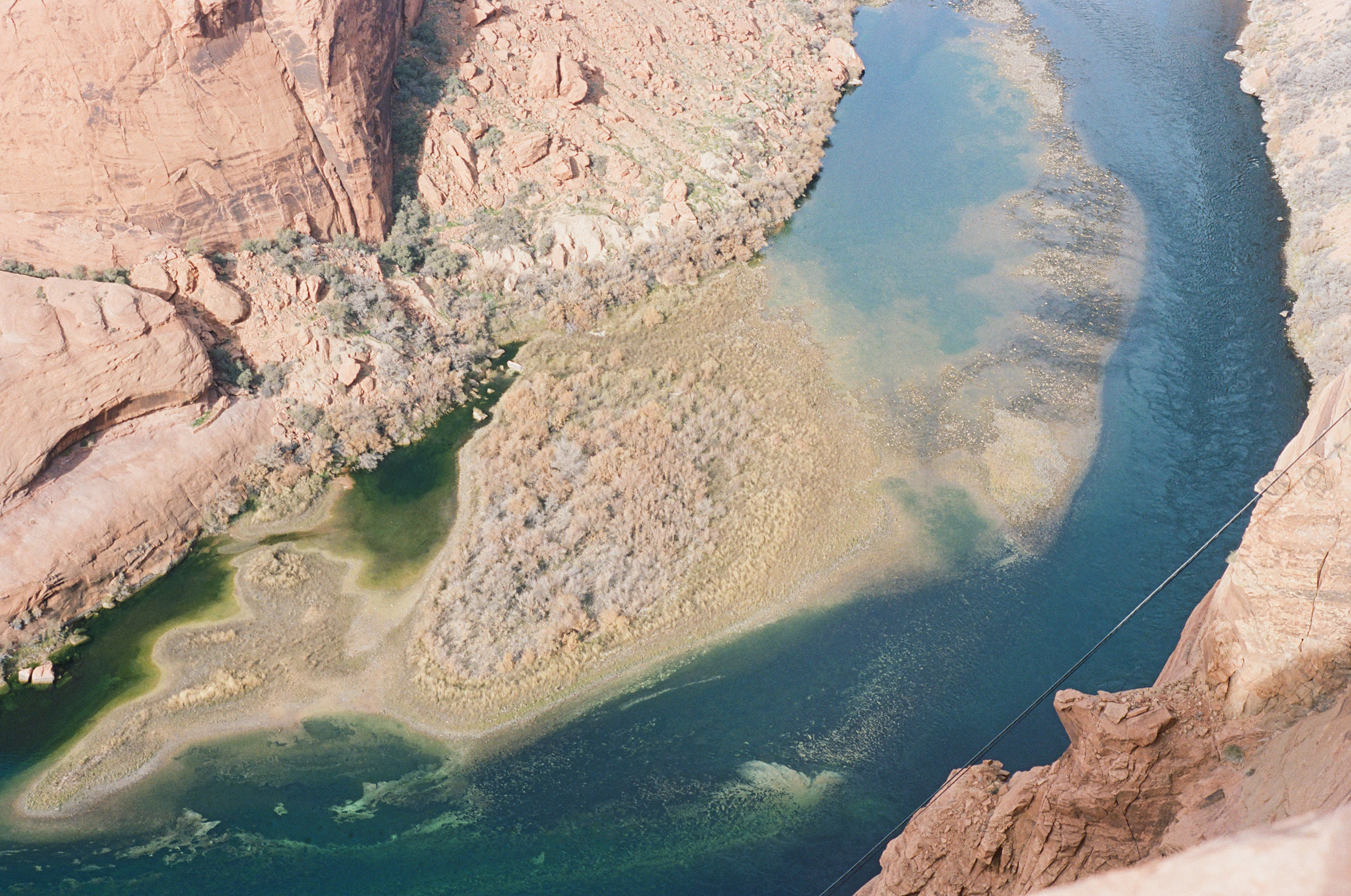
BEFORE THE DAM, and below it, where Lake Powell’s water releases from the dam’s outlets and becomes a river again, life blooms thick between Glen Canyon’s walls. Clumps of maidenhair ferns spill over cliffsides and columbines burst out from high ledges. The river’s shorelines are splotched green with coyote willow, prickly pears, and also with invasive ravenna grass. Microbes paint dark and shining stripes over rock faces, whiptail lizards scurry across sun-warmed boulders, great blue herons stalk among the sedges, and non-native trout wend through pondweed, which bends gently along the river’s bed. 1
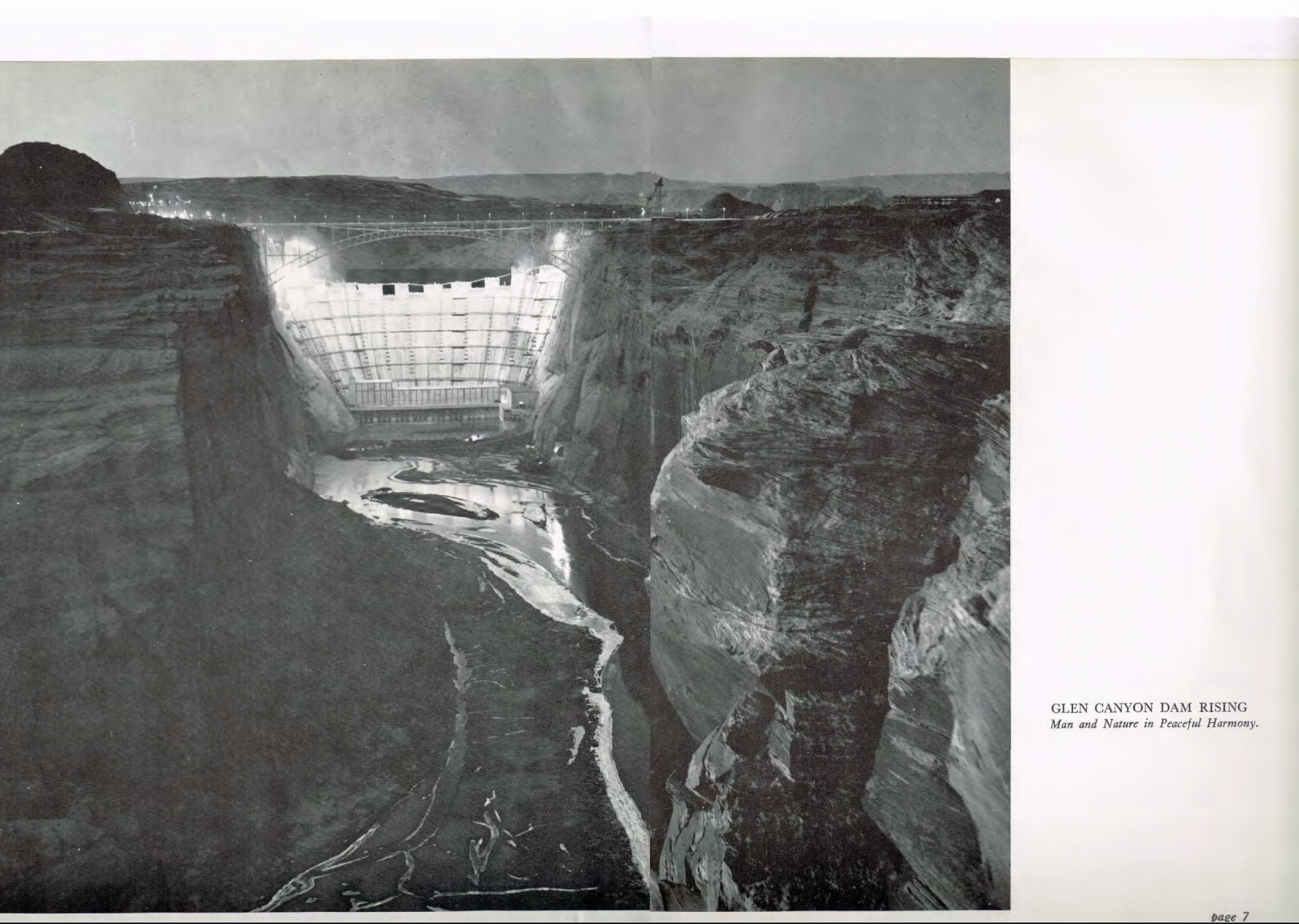
I never saw Glen Canyon in all of its “luxuriant verdure,” nor the thousands of mossy grottoes, oak-shaded beaches, and alcoved glens that inspired its English name. 2 Since the dam’s completion in 1963, most of the Canyon and the life it sheltered have been subsumed by the deep waters of Lake Powell.
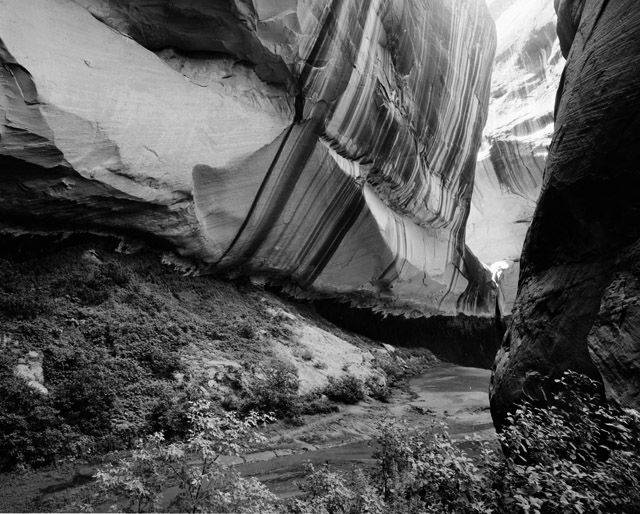
Lake Powell drowned 186 miles of Glen Canyon’s main stem as well as the nearly 100 side canyons which branch out from the central canyon like centipede legs. Only the final fifteen miles of Glen Canyon remain undammed – though the dam also wrought cascading and often lethal impacts to ecosystems downstream.
The river’s seasonal flood pulse – which for millennia delivered necessary moisture and nutrients to the Canyon’s shoreline – is now held back by the dam. The dam also traps nearly all of the river’s sediment, and as a result, riverside beaches are going unreplenished and washing away. Native vegetation has declined sharply since the dam’s completion. Goodding’s willow and Fremont cottonwood have almost entirely disappeared from Glen and Grand Canyon’s shores, taking with them critical shade for wildlife. 3
Before the dam, the Colorado River ran warm and muddy. Fish like the humpback chub, Colorado pikeminnow, and razorback sucker evolved specifically for these conditions – in fact, these fish can’t be found in any other river system in the world. But because the dam releases water from the reservoir’s bottom, the river now flows cold and clear, and many of its endemic fish teeter on the edge of extinction.
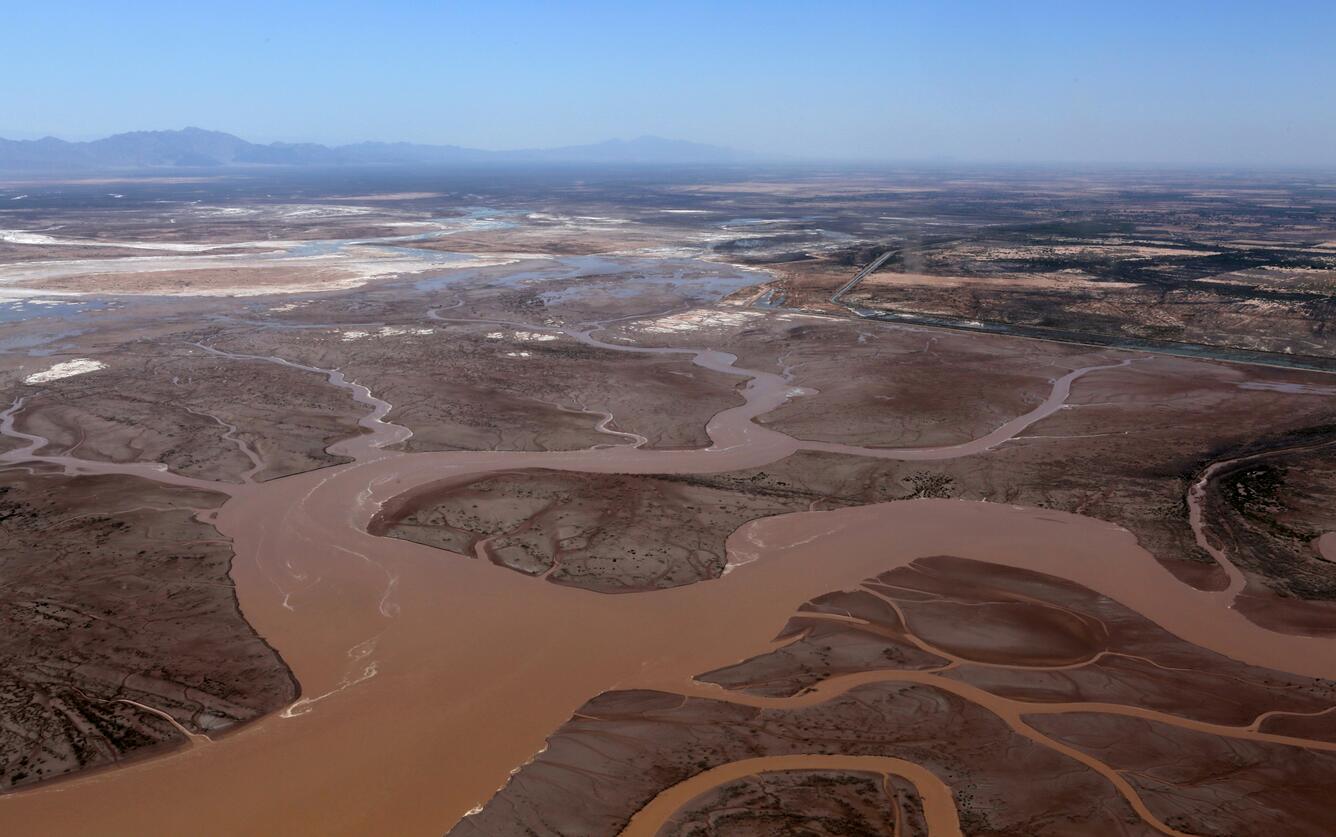
1,500 miles below Glen Canyon, the Colorado River used to fan itself out across a vast alluvial plain before draining into the Gulf of California, creating 3,000 square miles of marshland that homed cormorants, beavers, jaguars, coyote, and countless others. Since 2014, the river has not reached its delta but has dribbled out just south of the U.S.-Mexico border. The once lush estuary, braided with lagoons and verdant with all kinds of life has been transformed into a dusty mud flat, and an “untold wealth of wildlife” has disappeared. 4
In short, the Glen Canyon Dam helped to decimate, squeeze, and alter the conditions of life for innumerable living beings. The loss here is unthinkable; in Glen and Grand Canyons alone, 23 animal species have been extirpated, including the yellow-billed cuckoo, the zebra-tailed lizard, and the southwestern river otter, which is now deemed extinct – gone forever. 5 It is difficult to conceive just how many lives have been made difficult, lonely, short, painful, or impossible since the dam.
The Glen Canyon Dam, however, was not built for the purpose of destroying life. The dam and its reservoir were sold to the American public as a life-making project. By harnessing the river, stockpiling its waters, and redistributing its flows, the Bureau of Reclamation promised that the dam would transform the Colorado River from a “natural menace” into a “life-giver, and power producer, a great constructive force.” Its waters, the Bureau said, would provide “opportunities for many new homes and for the growing of crops that help to feed this Nation and the world.” 6 By turning the river into a productive machine, life – for humans, and more specifically, for settlers – could scale up. Indeed, forty million people now inhabit the lower basin, many of whom depend on the hydroelectric resources produced, managed, and distributed by Colorado River dams and their reservoirs.
There is a striking imbalance at play here between the life that the dam has enabled and the life it has extinguished. On the one hand, the dam has harnessed the resources necessary for some life to progress and proliferate at a rapid pace. In this light, the dam might be understood as a kind of technological prosthetic that has allowed human evolution to continue its advance along Darwinian trajectories of growth and expansion. On the other hand, this advancement is dependent on the accumulation, extraction, and mobilization of resources that once granted local inhabitants the means to reproduce, survive, and thrive.
In this sense, the Glen Canyon Dam and Lake Powell are just another familiar site of industrial exploitation and ruination. Like the factory or the mine, the material conditions that enable existence have been separated from their sites of origin and reallocated towards sites of wealth. In the process, Glen Canyon’s ability to materially support local life has been depleted and subsumed.
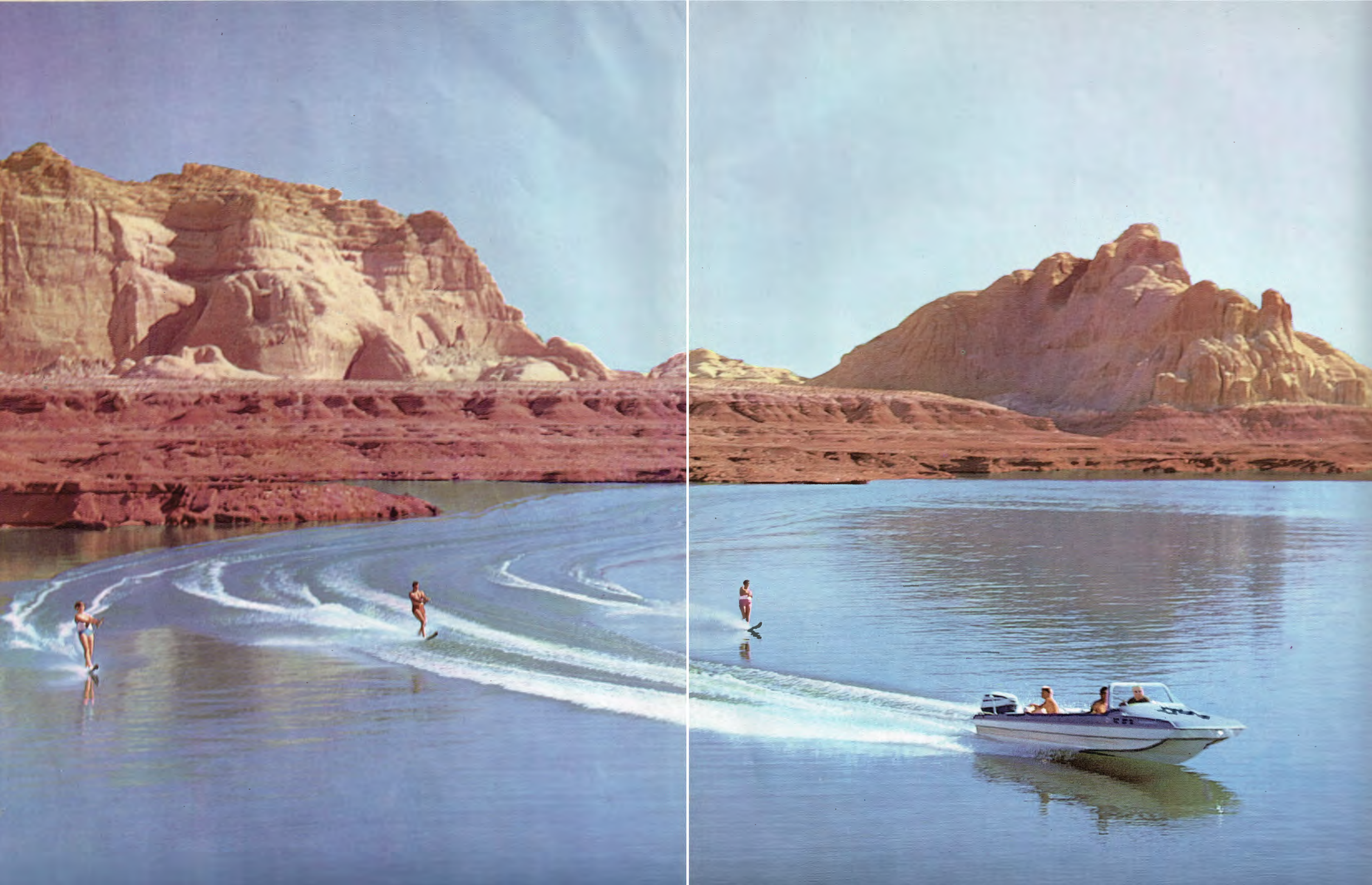
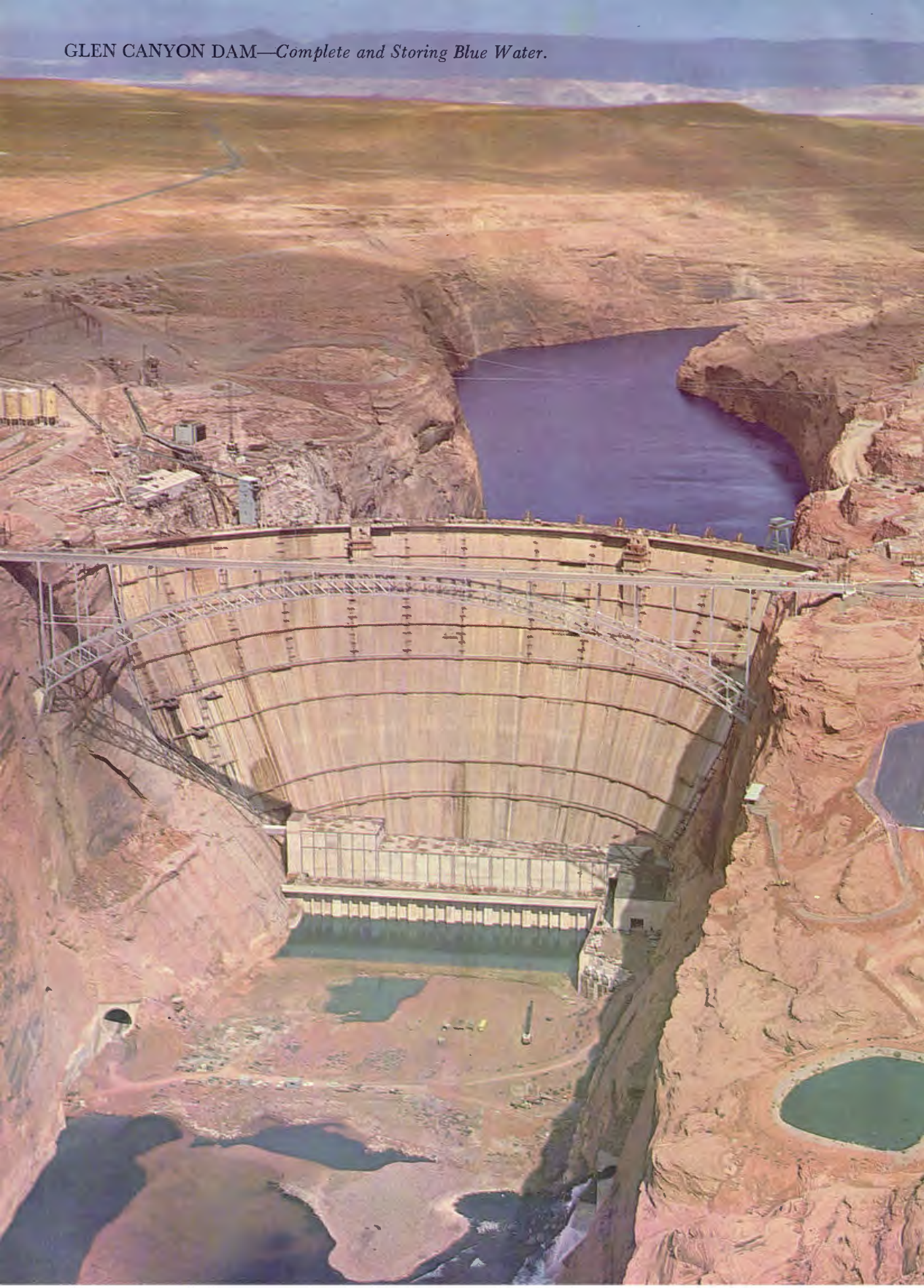
When I look at images of Lake Powell at full pool, the contradictory promises of technocapitalist progress appear written in the landscape. The expanse of deep blue water signifies a moment of peak resource-richness in the basin; water and electric power has been successfully stockpiled, assuring settler life and industrial growth for years to come. But the water – and the life it enables elsewhere – contrasts vividly against a backdrop of bare rock, which is markedly stripped of life. There are none of the plant thickets that tend to crowd along water edges, no hum or sign of animal existence. At full pool, Glen Canyon is transformed from living ecosystem into a sterilized machine as its resources are harnessed and diverted for life somewhere else.
Philosophers Gilles Deleuze and Félix Guattari might label Lake Powell as an apparatus of capture or a megamachine – that is, a site in which the free flows of water, land, and life have been captured, divided, and converted into productive power for the State. But Deleuze and Guattari also remind us that even the most rigid structures of capture are riddled lines of flight, or opportunities for escape. Mechanisms of containment and control, they suggest, are always susceptible to leakages and pressure breaks. 7
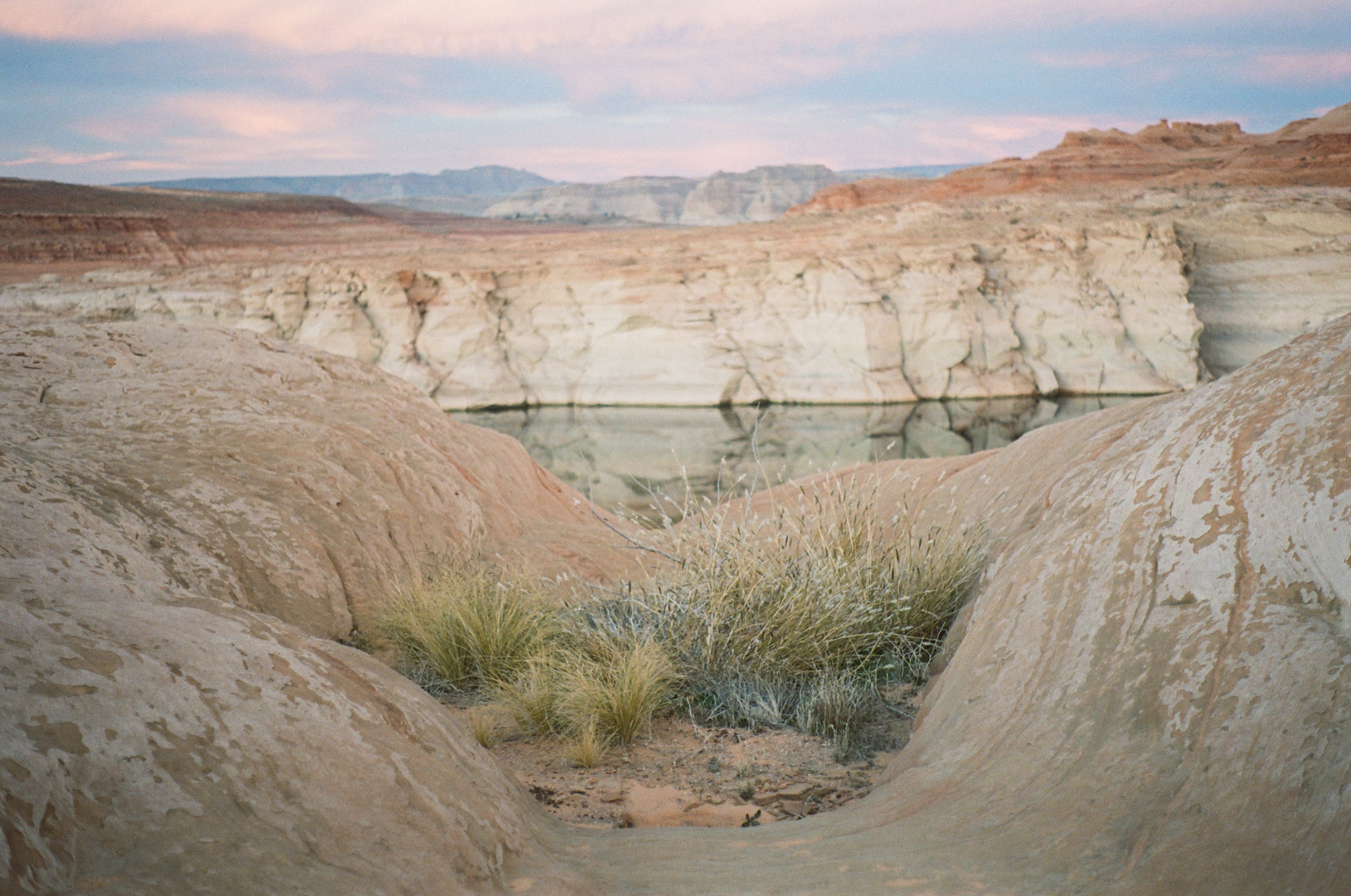
When I visited Lake Powell in the last days of 2025, I met a landscape that was neither rich with stockpiled water, nor stripped of life. Since the lake reached full pool in 1983, the machine had become exhausted and sprung leaks; Lake Powell had lost most of its water, the dam teetered toward obsolescence, and life had once again begun to bloom along the lake’s verges. Today, Glen Canyon is teeming with existences lost and mutilated, but also with existences that have escaped the capture of the Glen Canyon Dam.
I set out in this project to read Glen Canyon’s landscapes for the tracks and traces of the past, a practice that often swept me into the realm of ghosts and loss. I scoured archival photographs for evidence of what was once there but is no longer: the hoof prints of animals extinct or displaced and the signs of spring floods that haven’t occurred in years. This approach, I thought, would help me resurface stories subsumed by the dam, memorialize a fragment of what has been lost.
But I have learned that Glen Canyon is not a site of uniform and linear degradation, and I can no longer build an archive of totalizing loss – not only because such forensic accounting would exclude the many forms of existence that persist in Glen Canyon, but because it would “cement in place”8 the claims of inescapable control and capture upon which technocapitalist systems rely. An archive of the dam’s victims would also be an archive of the dam’s power.
Instead, as J.K. Gibson-Graham urge, I am interested in writing about “the other worlds” that live amidst capitalist ruins and cataloging the “diverse economies that are already here.” Glen Canyon is densely packed with living beings who practice resource exchanges and enact social relations which defy capitalist logics. By focusing on these other, nonhuman economies, I follow J.K. Gibson-Graham in writing to “perform” their possibility into being and nudge alternate formulas of survival closer to the surface. 9
So I am interested in not only memorializing biotic loss, but also in following biotic lines of flight, in tracing the paths of escape from the Glen Canyon Dam. I am paying attention to the life that is, to borrow a phrase from my friend Jack, “non-reactive to the light” of capitalism, accumulation, and progress – or perhaps reactive to different kinds of light. 10 In doing so, I hope to keep at the surface the kinds of living arrangements, subsistence strategies, and resource exchanges that precede, survive, and exceed capitalist booms and busts. I hope to build an archive of persistence and possibility, and look toward what kinds of existence might come after the Glen Canyon Dam.
Leaky Dams
HUMANS ARE NOT the first or only species to build water-storage infrastructure, or to stockpile resources in order to assure future life. Beavers, of course, also build dams and engineer ponds, and they cache food stores to last them through the winter months. Yet beaver dams – when built in native beaver habitat – enable other kinds of life to flourish rather than drown everyone else out.
In Glen Canyon’s beaver ponds, Red-Spotted and Woodhouse Toads find the shallow and slow-moving water they need to breed and lay their eggs, as do mayflies and caddisflies. Flycatchers and dippers, pikeminnows and razorback suckers all gather at beaver ponds to feast on hatching bugs. Before the dam, before they went extinct, Southwestern river otters visited beaver ponds to hunt pikeminnows, toads, fly nymphs, and even beaver kits. 11
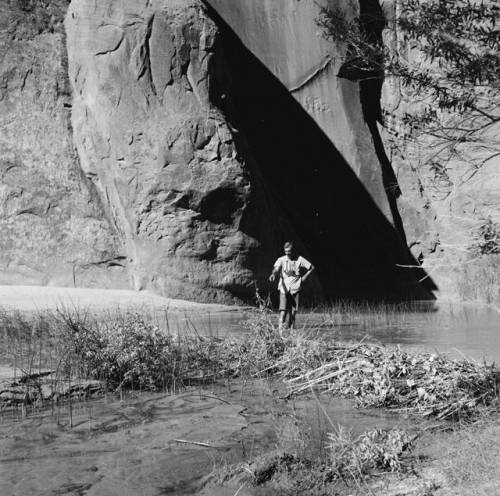
Infrastructure and accumulation, beavers show us, are not inherently selfish or destructive. But beaver dams and man-made dams differ widely in both their forms and functions. Beaver dams are leaky and full of cracks; fish, larvae, and microorganisms move constantly between their latticed sticks, and water seeps through porous mud. Life – water, nutrients, soil, biota – continues to flow and move through beaver dams, even as beavers accumulate what they need to survive and raise their young. Beaver dams work to collect resources like water and consumable energy, but they do so without enacting totalizing containment and control over their environments.
Beaver dams and ponds are also built at a vastly different scale than human-made dams, which is why beaver infrastructure can boost biodiversity while human dams tend to diminish it. Beaver ponds are relatively small and shallow, and tend to create wetlands – ecosystems that are neither wholly aquatic nor wholly terrestrial, but a rich mixture of both. These amphibious terrains draw life of all kinds – land mammals and trees convene closely with marsh plants and fish. Beavers make landscapes patchier, and they also create gathering places where distinct biotic worlds meet, touch, and intermingle. In beaver wetlands, the borders between land and water blur as water, sediment, and vegetal growth constantly rearrange the contours and boundaries of the pond.
Reservoirs, on the other hand, inundate landscapes completely, often beneath many hundreds of feet of deep and stagnant water. Reservoirs draw sharp boundaries between water and land; they reserve space exclusively for water storage and hold terrestrial worlds apart and outside. Reservoirs, by design, are not patchy, shallow, or leaky; they are homogeneously watery, and they are designed to seal their water in tight.
The difference in scale between human dams and beaver dams is of course tied to the number of beavers and people each infrastructure is intended to support. Beaver dams typically sustain just one beaver family, whereas human dams can sustain millions of people. But infrastructural scale – and the scale of its attendant benefits or damages – is also determined by the degree to which each species depends on local resources for survival. It makes no sense for a beaver to construct a pond so large one season that it drowns local trees the following year. The beaver will need next year’s trees to maintain their dams and lodges as well as to eat. Beaver longevity hinges directly on the beaver’s ability to balance accumulation with restraint.
But most humans in the Global North are sustained by goods imported from places hundreds or thousands of miles away. One resource field can be completely exhausted without interrupting the broader flow of goods – as long as there are resources to be extracted from elsewhere. In this system, next year’s resources are promised not by their immediate or visible availability, but rather by a speculative market that assures consumers goods can be sourced from “somewhere else.” Because this system abstracts material goods into intangible capital exchanges, that “somewhere else” does not need to be specified in order to assure consumers of its future potential. In this system, life is maintained by a network of invisible, distributed, and abstract somewhere elses that can be thoroughly plundered without many visible consequences.
I could not name each distant forest, mountain, or ocean that was razed, sucked dry, and scoured in order for me (a middle-class woman in the U.S. who attains almost all my goods from globalized markets) to get through my day fed, housed, and clothed. One forest can be exhausted completely, even to the point where it will bear no more trees for decades to come, and yet my ability to buy a paper journal next year will not change. In fact, my paper journal may become cheaper as timber industries become more efficient, which is another way to say unrestrained.
When consumers are so radically dislocated from the origins of our resources – when landscapes are transformed from places where people and animals and plants live into resource fields to serve life elsewhere – there is scant incentive to practice restraint, and all the incentive to maximize efficiency. Thus, human infrastructure is often designed to accumulate and extract as much as possible, because the future can be sourced from an invisibilized somewhere else.
The underlying differences, then, between beaver dams – which in their leaky shallowness beget other life – and human dams – which in their resolute capture drown other life – is not driven only by the materials used or populations served, but is also bound up in how far afield each of our resource networks penetrate and disperse, and how far removed consumers are from the origin of their goods.
It seems obvious here, then, to advocate for more localized economies, and for more leaky and shallow infrastructures that do not make attempts at totalizing containment and control. And I am – but I wonder if global connectivity could also be helpful for drawing distant and abstract resource fields closer into our view. In the information age, and especially in the digital age, it has become easier and easier to witness the impacts of our consumptive practices. Legions of scholars, activists, artists, and scientists have worked to document the consequences of unfettered extraction and super-scale infrastructures for both human and nonhuman communities. Informational connectivity, in other words, helps to reduce the dislocations and invisibilities encoded in existing globalized economies. As telecommunication networks draw communities across the globe into informationally local relationships with one another, it is becoming easier to imagine the world as one large ecosphere, in which diverse biosocial worlds meet, intermingle, and overlap, and whose futures are mutually contingent upon one another. We might, then, imagine building a global ecosystem that more closely resembles a beaver wetland; in which infrastructures are leaky and reservoirs run shallow – so that more life everywhere can thrive and survive.
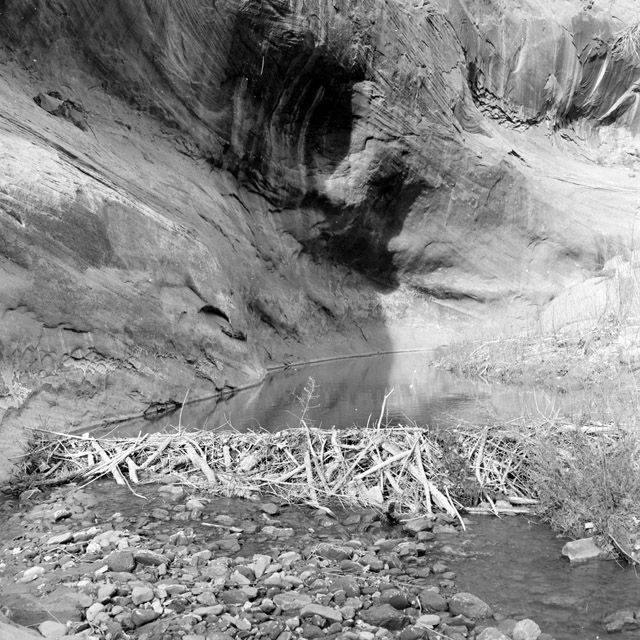
Most of Glen Canyon’s beaver ponds were drowned by Lake Powell. But as the lake ebbs away, beavers are returning, and building back, and the landscape is once again sprouting with kaleidoscopic life.
Mezosoic Lifeboats
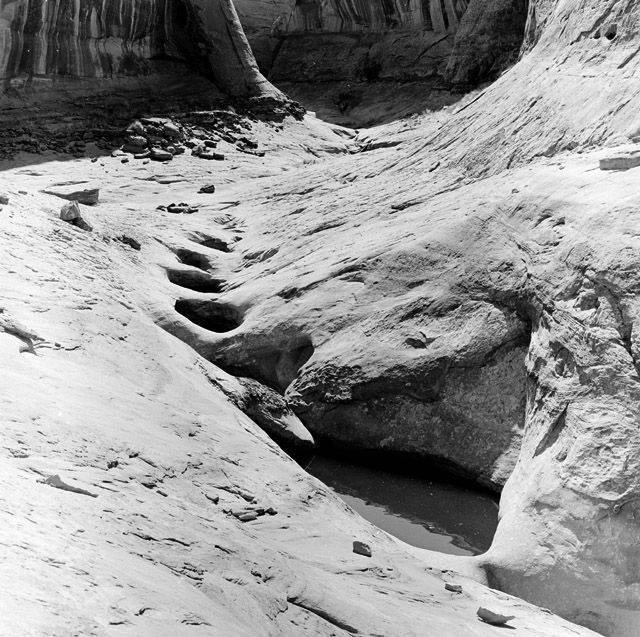
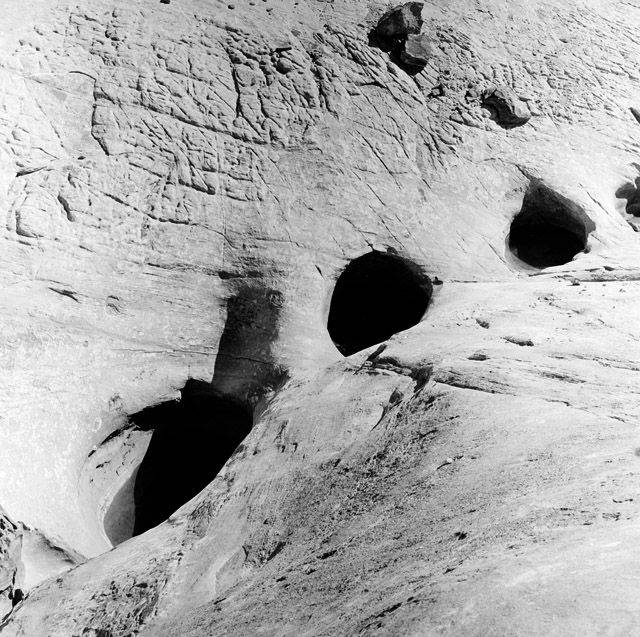
AFTER A RAINSTORM, thousands of glittering pools appear across the Colorado Plateau – and life explodes out from the earth, where countless creatures lie in suspended wait. The pools, which for much of the year are dry, darkened potholes, suddenly bustle with watery activity. For a frenetic few weeks, snails, mites, shrimp, nematodes, and tadpoles spin through their life cycles – hatching, eating, growing, breeding, and laying eggs – all of which must be done before the pools evaporate under the hot desert sun. But for most of the potholes’ organisms, life does not end when the water disappears; it only pauses, and waits.
As the pools dry up, snails and mites burrow into the muck and encase themselves in cocoons of clay. What moisture they lock into these casings will last them for months or even years until the water comes again.
Other organisms – like bacteria, algae, tardigrades, rotifers, nematodes, and the eggs of fairy and tadpole shrimp – enter into cryptobiosis: a state of dormancy in which their bodies become almost completely dehydrated and their metabolisms stop altogether. 12 Cryptobiotic organisms can exist in this mode of suspended living for a long time: fairy shrimp eggs have hatched after fifteen years of sitting on a dry shelf, and in 1998, a handful of eggs survived nine days in outer space. 13
Cryptobiosis means hidden (crypto) life (biosis) – a word that gestures at the challenges that cryptobiotics place on our understandings of what it means to live, die, and survive. Cryptobiotic organisms spend much of their time in a state that can’t quite be defined as living, but also can’t be called dead. Instead, cryptobiosis is a “third state” of existence that lies somewhere between life and death. During cryptobiosis, organisms do not metabolize, move, grow, respire, or reproduce – that is, they display none of the signs of life. But nor are they dead, because when the conditions become right for living again, they can reanimate, and go on eating, growing, moving around, and reproducing. 14 Cryptobiosis is a remarkable tactic for surviving an often harsh and changeable earth, and it presents a formula for living that runs askew from Darwinian notions that life is maintained via constant growth: for cryptobiotic species, the act of survival requires the suspension of life.
Dormancy is a time-tested strategy: cryptobiotics are some of the earth’s oldest species. Fairy shrimp have existed for an estimated 300 million years, and are often referred to as “living fossils” because they have hardly evolved over the course of their long existence. 15 That fairy shrimp have endured so long, and done so without evolving, is particularly remarkable given the radical changes that the earth has undergone in that same time period – 300 million years ago, the earth’s landmasses were heaped into the supercontinent Pangea.
Darwinism, which for centuries has underpinned Western biologic science, holds that life is in a state of perpetual improvement and change. These same logics have often been invoked to naturalize industrial capitalism, and its drive toward infinite accumulation and innovation – creating a self-perpetuating cycle where capitalism and Darwinism legitimize one another as life-by-endless-expansion seems to endlessly expand. 16
But fairy shrimp pose a challenge to Darwinian and industrial-capitalist rationales: even as the earth has completely rearranged itself, fairy shrimp have barely changed at all – nor have most of the organisms found in the ephemeral potholes of the Colorado Plateau.
The Plateau’s potholes are sometimes described as mezosoic lifeboat niches, because they have carried ancient life across the turbulent storms of time and change. Lifeboat organisms remind us that persistence does not necessarily demand constant growth, and progress is not the only way to ride out upheaval. Persistent survival can also mean dormancy, cyclicality, and patient waiting – life presents many formulas for achieving resilience during dry and stormy times.
Serpent Rain
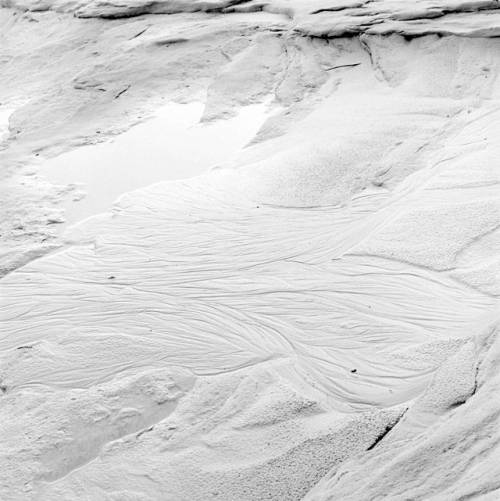
SOMETIMES, GLEN CANYON’S sand banks are cut with slithering tracks, as if thin rivulets of water have rippled across the ground. But these watery markings can appear before rain falls, and as Diné singer Ernest Nelson relays, the tracks are promises of rain to come rather than the traces of water already gone by. “The tracks of Rattlesnake can be seen, shortly before it rains, in ripples,” Nelson explains. “When they move about in this manner they are calling the Rain people… that is the way these Serpent people control the calling forth of rain.” 17
Snakes and moisture are commonly associated in Diné worldviews, because snakes move like lightning and rivers. And so for the Diné, the fates of water and snakes are closely intertwined: “Molest a snake,” anthropologist Robert McPherson writes, “and the rains will stop.” 18
Because the Serpent people dictate rain patterns, the well-being of life on the Plateau is bound up with the Snake, and his ability to “move about,” a point Nelson emphasizes when he describes the death of one of these Serpent people. Around 1932, Nelson came across the corpse of a Serpent-being who was killed by a White man. Since the Snake’s death, Nelson says, “things concerning us as a people have not been very good… it also seems as though our prayers and offerings do not work as before he was killed.” 19
Nelson outlines a relationship between the Diné people and water that is mediated through a nonhuman arbiter: water is assured through a reciprocal and respectful exchange between person and Snake being, and the defilement of one has lasting impacts on the other.
Biological Crusts
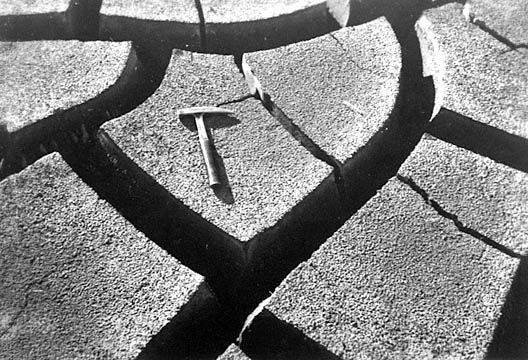
SINCE THE TURN of the millennium, the West has suffered a period of intense aridification: the climate is increasingly hotter and drier, yearly rain and snowfall is declining, and reservoirs across the West are drying up. 20 Climate changes can often set off feedback loops – cycles in which one change amplifies another, which amplifies another, and so on. Feedback loops make ecological futures difficult to predict, because so many elements are liable to shift at once, impacting and being impacted by one another via an ever-emerging circuitry of interrelated contingencies.
As Lake Powell recedes, it leaves behind vast beds of exposed dust, which blow into the atmosphere and sift down over the snowfields at the Colorado River’s headwaters. When this happens, the snow loses much of its ability to reflect the sun, and melts quicker – which means more water is lost to evaporation each year – which means more dust will be exposed the next year – and snowfields will melt faster the next – and so on. 21
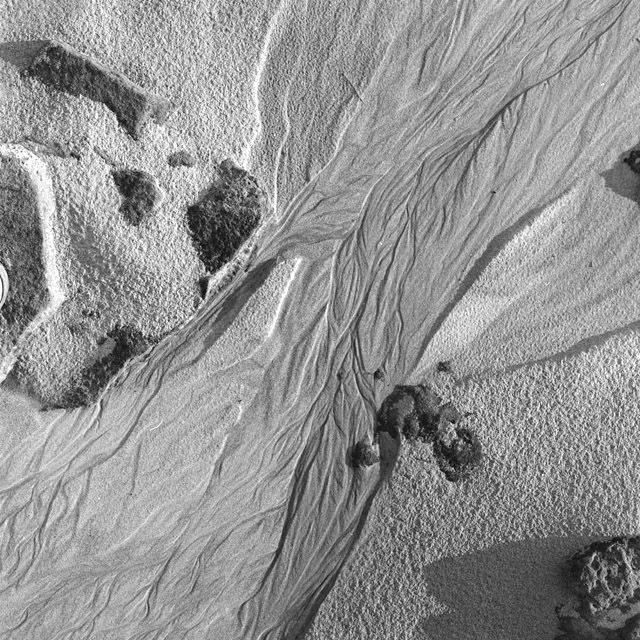
But the lake’s retreat has also ceded back habitat to the Plateau’s microbial life, which might help counter – or at least slow – the spiral towards an out-of-control dust-drought cycle. Across the lake’s dry beds, communities of cyanobacterium, lichen, mosses, and microfungi are regrowing. When it rains, these organisms wriggle like “little worms” 22 through the sand, weaving fibrous connections between one another and binding dust particles together with sticky filaments that remain in place even after the organisms themselves die. Together, these communities create a biocrust that stabilizes the dust and increases soil’s ability to absorb and retain water. 23
Desert crust organisms cooperatively transform landscapes and climates, making livable worlds for other beings. As crusts hold the loose earth and moisture in place, plants take root, and animals follow. Yet the impact of these tiny creatures stretches far beyond their local beds – each filagreed connection they build keeps a bit of dust in place, out of the atmosphere, away from the snowfields of the Rockies. The infinitesimal actions of microscopic organisms cascade into climatic-level impacts. If left alone – undrowned – desert crusts will help transform the dried-up mud beds of Lake Powell into a vibrant ecosystem, blooming with life both old and new.

When Fish Fly

FIVE MILLION YEARS ago, upwelling magma lifted a block of the North American continent six thousand feet into the sky, creating a high tableland that, to this day, towers over the Western United States like an island in the sea. 24 This is the Colorado Plateau, and as with islands, the Plateau’s biological communities have spent much of the last five million years in relative isolation. As a result, the Plateau’s ecosystems are among the most unique in the United States; many of its species are endemic, meaning they can’t be found anywhere else in the world.
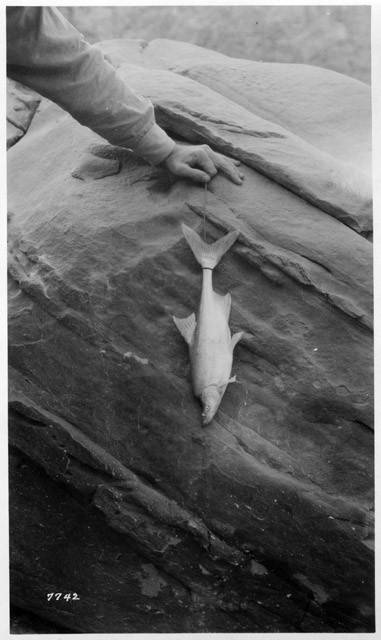
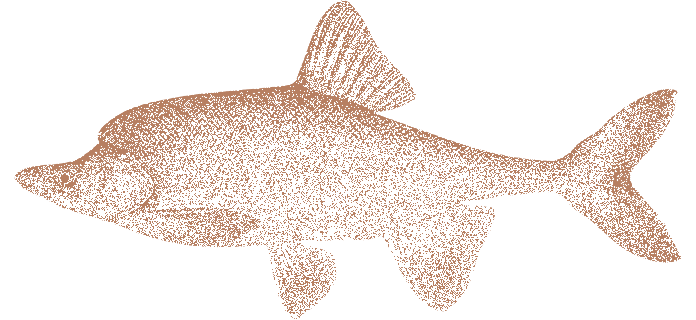
The Plateau’s fish have particularly high rates of endemnity: of its 35 native fish species, 26 are endemic, including the humpback chub, bonytail chub, razorback sucker, and Colorado pikeminnow, along with the flannelmouth sucker, bluehead sucker, and speckled dace. These fish have evolved distinctive traits that allow them to thrive in the Colorado River’s warm muddy waters and turbulent rapids. Humpback chubs’ trademark hump, for example, helps them to navigate the Colorado River’s fast-moving waters, as do the bony tails and razored backs of bonytails and razorback suckers. 25
But in the mid-19th century, the very same traits that enabled humpback and bonytail chubs to survive millions of years of life in a volatile river system also became the reason for their near extermination. As EuroAmerican settlers moved into the Colorado Plateau, they asserted their own metrics of “valuable life” on the Plateau’s ecosystems. These metrics often had little to do with ecological significance, preciousness, or adaptability, and everything to do with economic and cultural worth.
White anglers and government agents alike labelled the river’s native fish as ugly, undesirable “trash fish,” “rough fish” or “coarse fish,” and sought to replace them with economically and culturally valuable trout. As part of this effort, the U.S. Fish and Wildlife Service dumped 20,000 gallons of a pesticide called rotenone into the Green River (which feeds into the Colorado). An estimated 90% of native fish populations were wiped out, after which 3 million trout were dropped into the river. As with the Glen Canyon Dam, the State sought to transform a living ecosystem into an economic resource field in order to maximize settler economies. 26
By the 1970s, however, wildlife management practices had shifted as the environmentalist movement called for a different framework of evaluating non-human life. The Endangered Species Act of 1973 wrote into law a metric for appraising life based not on its commercial value, but instead on its inherent existential merit.
The humpback chub was named on the first Endangered Species Act in 1967, and by 1979, the government began diverting funding towards all kinds of chub recovery efforts, which began with extended studies, mandated water releases from the river’s dams, and captive breeding programs, and have since evolved into helicopter-assisted translocations. 27The goal with these programs (which, while enabling chub to rebound, still capture fish life in State-orchestrated techno-economic schemes) are ostensibly to restore chub to previous population levels – as if nature might be somehow returned to a pre-industrialist state without having to remove industrial infrastructure.
But as the river’s invasive trout continue to thrive and multiply in the Colorado River’s now clear and cold waters, they remind us that the future will always be altered and contaminated by the past. A return to pre-ruined Nature is not only impossible, but its attempt would likely require more violence and a continued assertion of human control over nonhuman lives and processes. But rejecting return-oriented conservation also does not mean we must simply accept the world as it is, with all of its current precarity, toxicity, and its infrastructures of degradation.
Instead, we might think about the kinds of “alterlives” that Michelle Murphy reminds us are still possible amidst the messes of capitalism, colonialism, and extractive industrialism. Alterlives, Murphy says, “names life already altered, which is also life open to alteration” via “alter-concepts of care and responsibility.” Alterlives might “proceed by calling forth alter-modes of collaboration and study that simultaneously aim at world-building and dismantlement.”28
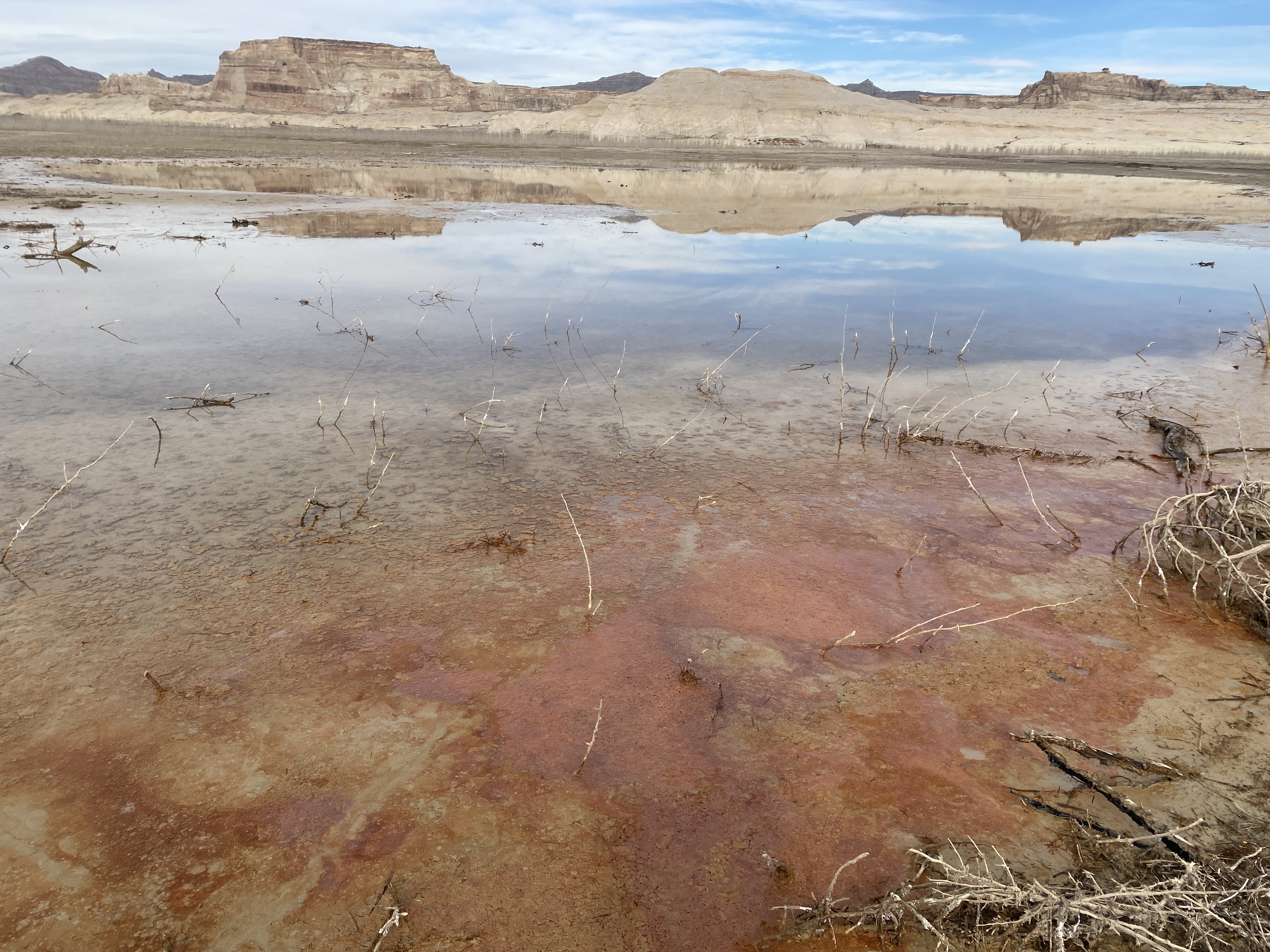
Today, the Colorado Plateau is no longer an isolated sky-island: it is replete with mutated landscapes and bright with new assortments of life. This terrain is often dangerous and difficult, but it can also be serendipitous with new opportunities for collaboration and survival.
Along the San Juan River – another one of the Colorado’s tributaries – a new land formation has grown up since the Glen Canyon Dam. As sediment backed up behind the lake’s rising waters, it packed itself into the river’s old bed. When the lake level dropped, the river bent a new course over the new sediment glaciers – a half-mile away from its pre-dam bed – cut down through the mud, and plummeted over a bedrock cliff, forming an 18-foot high waterfall.
Migrating pikeminnows and razorback suckers get stuck at the bottom of the falls – but so do non-native catfish and bass, which hunt native fish. Each spring, the U.S. Fish and Wildlife Service deploys employees and volunteers to Fatt Falls, where they spend weeks scooping up suckers and pikeminnows from below the falls, dropping them into five-gallon buckets, carrying them a quarter-mile upstream, where they release the young fish.
Behind the barrier of the waterfall, the pikeminnows and suckers are safe to spawn, grow, and carry on living. 27
Works Cited
-
See iNaturalist for a current catalog of Glen Canyon’s biota. ↩
-
Powell, John Wesley. The Canyons of the Colorado Flood & Vincent, 1895, p. 83. ↩
-
Grand Canyon Watershed Council. “Assessment of Taxa of Management Concern in the Colorado River Ecosystem, Glen and Grand Canyons, Arizona, USA: Habitat Needs, Availability and Ecosystem Roles.” United States Bureau of Reclamation, 2011. www.usbr.gov/uc/progact/amp/twg/2011-06-28-twg-meeting/Attach_09a.pdf ↩
-
“Colorado River Delta.” Colorado River Science. https://coloradoriverscience.org/Colorado_River_Delta ↩
-
Grand Canyon Watershed Council. ↩
-
Bureau of Reclamation. The Colorado River: A Comprehensive Report on the Development of the Water Resources of the Colorado River Basin for Irrigation, Power Production, and Other Beneficial Uses in Arizona, California, Colorado, Nevada, New Mexico, Utah, and Wyoming. United States Department of the Interior, 1946, p. 1. ↩
-
Deleuze, Gilles, and Félix Guattari. A Thousand Plateaus: Capitalism and Schizophrenia. Translated by Brian Massumi, University of Minnesota Press, 1987. ↩
-
Gibson-Graham, J. K. “Diverse Economies: Performative Practices for `Other Worlds’.” Progress in Human Geography, vol. 32, no. 5, Oct. 2008, pp. 613–32. https://doi.org/10.1177/0309132508090821, p. 614. ↩
-
Gibson-Graham, p. 620. ↩
-
Hager, Alex. “Busy Beavers Are Building Back as Lake Powell Retreats.” KUER, 30 Oct. 2025, kuer.org/science-environment/2025-10-30/busy-beavers-are-building-back-as-lake-powell-retreats ↩
-
Abe, Shige. “A Pothole in the Road of Life.” NASA Astrobiology Institute, NASA, 2002, astrobiology.nasa.gov/nai/articles/2002/5/6/a-pothole-in-the-road-of-life/index.html ↩
-
Eriksen, C.H. and D. Belk. Fairy Shrimps of California’s Puddles, Pools, and Playas. Mad River Press, Inc., 1999. ↩
-
Neuman Y. “Cryptobiosis: a new theoretical perspective.” Prog Biophys Mol Biol. 2006, pp. 258-267. doi: 10.1016/j.pbiomolbio ↩
-
Lindholm, M. “Morphologically Conservative but Physiologically Diverse: The Mode of Stasis in Anostraca (Crustacea: Branchiopoda).” Evol Biol 41, pp. 503–507, 2014. ↩
-
Ruse, Michael. Monad to Man: The Concept of Progress in Evolutionary Biology. Harvard University Press, 1996. ↩
-
Luckert, Karl. Navajo Mountain and Rainbow Bridge Religion. The Museum of Northern Arizona, 1977, p. 121. ↩
-
Robert S. McPherson, Sacred Land, Sacred View: Navajo Perceptions of the Four Corners Region, Charles Redd Monographs in Western History, no. 19, Provo, Utah: Charles Redd Center for Western Studies, Brigham Young University, 1992, p. 68. ↩
-
Luckert, p. 123. ↩
-
Williams, A.P., Cook, B.I. & Smerdon, J.E. “Rapid intensification of the emerging southwestern North American megadrought in 2020–2021.” Nat. Clim. Chang. 12, 2022, pp. 232-234. https://doi.org/10.1038/s41558-022-01290-z ↩
-
T.H. Painter, J.S. Deems, J. Belnap, A.F. Hamlet, C.C. Landry, & B. Udall, “Response of Colorado River runoff to dust radiative forcing in snow.” Proc. Natl. Acad. Sci. 2010. https://doi.org/10.1073/pnas.0913139107 ↩
-
Podmore, Zak. Life After Dead Pool: Lake Powell’s Last Days and the Rebirth of the Colorado River. Torrey House Press, 2024, pp. 139. https://www.torreyhouse.org/life-after-dead-pool ↩
-
Weber B, et al. “What is a biocrust? A refined, contemporary definition for a broadening research community.” Biol Rev Camb Philos Soc. 2022. doi:10.1111/brv.12862 ↩
-
Roberts, G.G., et al. “An Uplift History of the Colorado Plateau and Its Surroundings from Inverse Modeling of Longitudinal River Profiles.” Tectonics, vol. 31, 2012. doi.org/10.1029/2012TC003107 ↩
-
Minckley, W.L., et al. “A Conservation Plan for Native Fishes of the Lower Colorado River.” BioScience, vol. 53, no. 3, 2003, pp. 219–234. ↩
-
Williams, Ted. “Sometimes, It’s Trout That Have to Be Killed.” High Country News, 21 Apr. 2003, www.hcn.org/wotr/sometimes-its-trout-that-have-to-bekilled/ ↩
-
Williams, Ted. “Recovery: Humpback Chubs, New Values and New Hope for Endangered Native Fish.” Cool Green Science, The Nature Conservancy, 25 Oct. 2016. blog.nature.org/2016/10/25/recovery-humpback-chubs-new-values-and-new-hope-for-endangered-native-fish/ ↩ ↩2
-
Murphy, Michelle. “Alterlife and Decolonial Chemical Relations.” Cultural Anthropology, vol. 32, no. 4, 2017, pp. 494–503. https://doi.org/10.14506/ca32.4.02 ↩