1876:
Hayes v Tilden
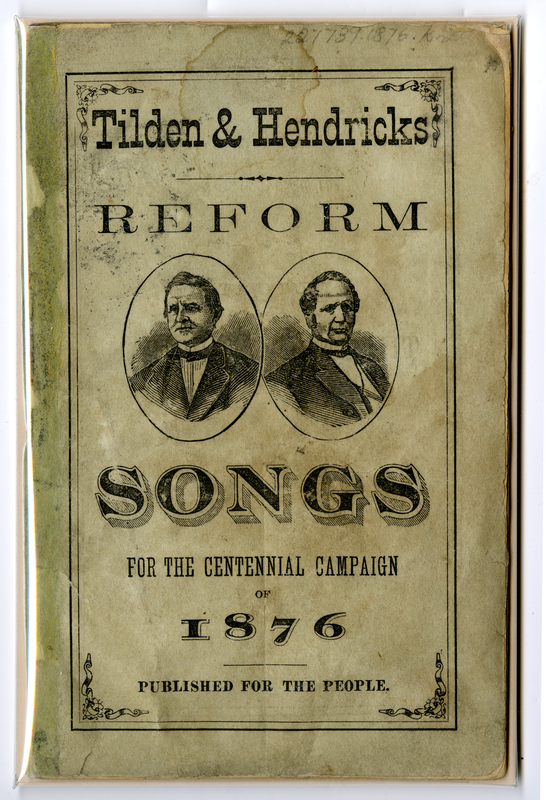
Hayes v Tilden
In the 1876 election, the Republican Party nominated Rutherford B. Hayes to succeed President Grant, whose second term was coming to an end. Hayes’ nomination was contentious, as he battled six other candidates through seven rounds of voting before being nominated1. On the other side, Democrats overwhelmingly nominated Samuel Tilden. Tilden was seen as a “reform” candidate for Democrats, aiming to end both Reconstruction and the concentration of power within the federal government1.
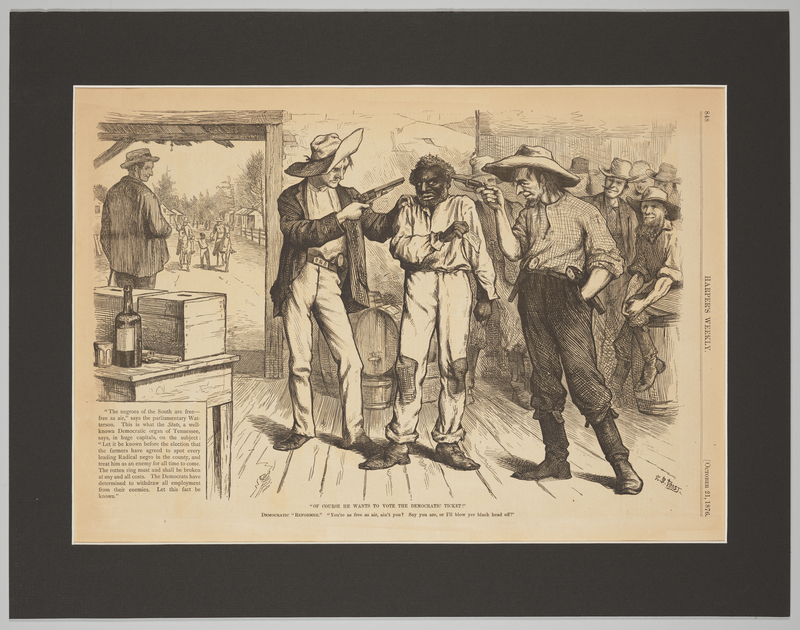
The weeks leading up to and the events of election day were fraught with accusations of illicit activities by both parties. Republicans alleged that voter suppression and intimidation by Southern Democrats against Black Republicans occurred in South Carolina and Louisiana1. The image below illustrates Republicans’ claims about the actions of Southern Democrats. Widespread reports of Democrats harassing Black Americans at the ballot box circulated1. At the same time, Republicans were accused of committing voter fraud in Florida1. After election day, both candidates proclaimed victory2.
Before the results of South Carolina, Florida, and Louisiana were determined, the electoral vote count stood at Tilden: 184; Hayes: 165 3. Twenty electoral votes were still in question: 19 from the three southern states, and 1 from Oregon3. It appeared that Tilden won each of the southern states on election day; yet, Republican returning boards responsible for certifying the election in each state invalidated the results3. The state boards argued that incidents of voter fraud, suppression, and intimidation manipulated the returns3. Additionally, officials in Oregon deemed one state elector ineligible as the elector held a federal position at the time4.
After election day, the results solidified at Tilden 184, Hayes 165. 20 votes were in question, with 185 votes needed for a majority in the electoral college. Tilden stood only one vote away from securing victory. However, like in 1800 and 1824, Congress would decide the contest.
Electoral Commission
Faced with an electoral crisis, Congress convened in early 1877 and agreed to set up an electoral commission to award the 20 disputed votes2. The commission consisted of 15 members, split 7-7 between Republicans and Democrats, with one independent2. While the commission was set up to be impartial, the independent Supreme Court justice refused to serve on the panel1. Ultimately, Justice Joseph Bradley of the 5th Circuit, a Grant appointee, was agreed upon by the commission to take the final spot1.
Unfortunately for Tilden and Democrats, each commission decision sided with Hayes down party lines2. Bradley voted with fellow Republicans at every turn1. At the conclusion of the committee’s proceedings, each disputed state was handed to Hayes via an 8-7 vote3.
Hayes was awarded the election by a one-vote margin, 185-1841. Similar to Andrew Jackson in 1824, Tilden won the popular vote and lost the election.
The Compromise of 1877
Threatening to tie up Hayes’ electoral victory in Congress, Democrats demanded a few guarantees in exchange for a peaceful inauguration3. First, Hayes needed to withdraw all federal troops from the South2. On top of that, he needed to appoint a Southern Democrat to his cabinet, fund the transcontinental railroad in the South, and pass laws to help industrialize the region2. With the threat of political violence looming and potential civil war, Hayes and Southern Democrats privately agreed to terms5.
Known as the Compromise of 1877, Hayes followed through on the most impactful of the Democrats’ demands. He withdrew remaining federal troops from both New Orleans, LA, and Columbia, SC, abandoning the Republican governments in both states1. Southern Democrats took control of both states shortly thereafter1. Ultimately, the rights of Black Americans at the time had been traded for the presidency5. Jim Crow laws, poll taxes, literacy tests, and white southern terror consumed the South for the next 80+ years.
References
-
Haworth, P. (1906). Hayes-Tilden Disputed Presidential Election of 1876. Cleveland, Burrows Brothers Company. ↩ ↩2 ↩3 ↩4 ↩5 ↩6 ↩7 ↩8 ↩9 ↩10 ↩11
-
Adkins, R. E. (Ed.). (2008). The evolution of political parties, campaigns, and elections: Landmark documents, 1787-2007. CQ Press. ↩ ↩2 ↩3 ↩4 ↩5 ↩6
-
Blackford, S. (2020, September 30). Disputed Election of 1876 | Miller Center. Millercenter.org. https://millercenter.org/the-presidency/educational-resources/disputed-election-1876 ↩ ↩2 ↩3 ↩4 ↩5 ↩6
-
Kennedy, P. W. (1969). Oregon and the Disputed Election of 1876. Pacific Northwest Quarterly, 60(3), 135–144. ↩
-
Woodward, C. V. (1991). Reunion and Reaction: The Compromise of 1877 and the End of Reconstruction. Oxford University Press. https://doi.org/10.1093/oso/9780195064230.001.0001 ↩ ↩2