1960:
Kennedy v Nixon
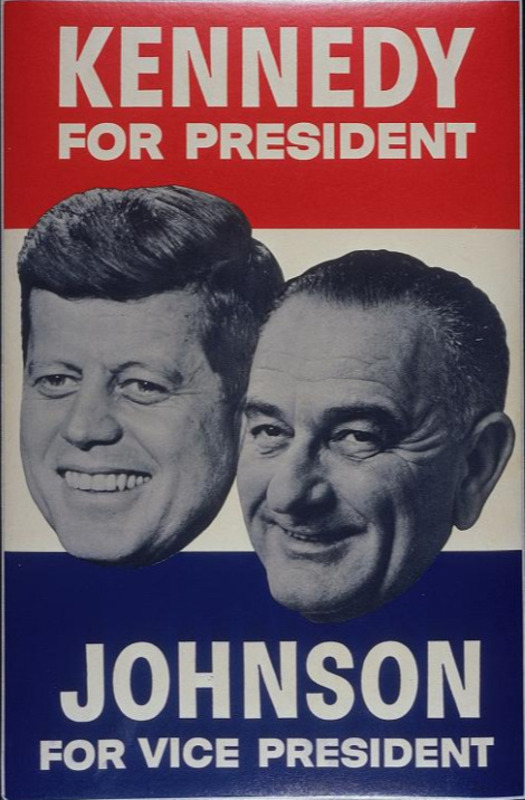
Kennedy v Nixon
In 1960, issues of the Cold War and civil rights were top of mind1. The recent downing of an American spy plane over the U.S.S.R., along with warming Cuban-Soviet relations, presented new challenges for America’s global influence1. At the same time, the U.S. economy slowed in 1960, presenting fresh obstacles for the next president2.
Leading up to 1960, with Eisenhower’s coming exit after two terms in the White House, both political parties were charting new courses. After the disappointment of Adlai Stevenson’s failed campaigns against Eisenhower in 1952 and ‘56, Democrats were eager for a new opportunity at the White House3. Despite his relative inexperience and the controversy of his Catholic background, John F. Kennedy won the nomination over Hubert Humphrey and other, more experienced candidates3.
On the Republican side Eisenhower’s vice president Richard Nixon battled Gov. Nelson Rockefeller of New York for the nomination. Rockefeller represented the more liberal side of the Republican party, in favor of expanding social safety nets and raising taxes2. Nixon, on the other hand, had the support of the party’s right flank, led by the ascendant Barry Goldwater2. After the convention, Nixon emerged as the party nominee, bridging the Republican divide2.
A Rollercoaster of an Election
In the weeks before the election, national polls had the race as a toss-up2. After a disappointing first televised debate, Nixon was virtually tied with Kennedy heading into election day3.
At the start of election night, the returns showed a Kennedy blowout3. He led Nixon by over a million votes and held a substantial lead in the electoral college3. TV anchors and network computers predicted Kennedy would surpass 400 electoral votes4. Then the tide began to turn back in Nixon’s favor. Ohio went to Nixon, along with much of the South. Suddenly, the margin in the electoral and popular votes tightened4.
However, to Republicans’ dismay, Kennedy was declared the winner the next morning4. He was projected to win California, Illinois, and Texas, three of the largest electoral prizes4. Kennedy had 332 electoral votes, compared to 191 for Nixon2. Nixon formally conceded the race shortly after, and the election appeared over2.
Still, over the next few weeks, the margin between the candidates in California slimmed2. A week after the election, on November 16th, Nixon officially took the lead in the state2. And on November 21st, California officially went to Nixon2. The White House was now within striking distance for the Republican nominee.
Democratic Fraud?
Despite flipping California, Nixon still needed the results in Illinois and Texas overturned to win the election. At the time, Kennedy led both states by fragile margins4. Kennedy’s margin over Nixon in Illinois was a mere 8,800 votes out of 4.7 million cast5. His lead in Texas was larger but still slim, at 46,000 votes out of 2.3 million cast5.
Republican advisors to Nixon informed him of widespread reports of voter fraud in both Illinois and Texas3. RNC Chairman Thruston Morton insisted that the vice president challenge the results3. However, Nixon was not enthused and actively campaigned against Republican efforts to change the outcome2. Nonetheless, Morton ordered Republican party officials in 11 states to investigate the results2.
The crux of the fraud allegations in Illinois came from Chicago, where Democratic Mayor Richard Daley ran a highly efficient political machine2. Reports ranged from ballots being dumped into the river to solely Republican ballots being voided in Chicago precincts3. On election day, Kennedy called Daley, and Daley reportedly told him, “with a little bit of luck and the help of a few close friends, you’re going to carry Illinois”.3
In Chicago, voter turnout reached 89%, a full 25% above the national average3. Some precincts reported more votes than registered voters. One Chicago precinct with 50 registered voters recorded 79 votes, with one voter dropping 6 ballots off4. In Chicago’s Ward 2, Precinct 50, with only 22 registered voters, 74 votes were cast for Kennedy3. Moreover, the Vice Chair of the Committee on Honest Elections, Frank Durham, exclaimed that the fraud in Chicago was “the worst he has seen in more than two decades of poll watching”.3
In Texas, Democrats controlled each lever of the state’s political power at the time3. Kennedy’s VP nominee, Texas Senator Lyndon B. Johnson, assured Kennedy that he would deliver the state for their ticket3. At the time, Texas elections were often manipulated by corrupt practices3. For instance, when Johnson lost a special Senate race in 1941, he claimed the winner “out-stole him”3. Additionally, in the 1960 election, Texas ballots required voters to strike through each candidate they were NOT voting for, leaving the preferred candidate’s name unmarked. As a result, many ballots were called into question. Republicans claimed that most voided ballots in Texas were in Republican counties and precincts3.
Ultimately, Republican officials in both states attempted to investigate the charges4. Despite efforts at statewide recounts, Republicans failed to uncover enough conclusive evidence of fraud to overturn the results. The states each certified their counts, and Nixon presided over the counting of the electoral votes in January 1961, certifying Kennedy as the winner.
Nixon’s Decision
As mentioned, Nixon was not a proponent of contesting the election results. While Morton and parts of the Republican establishment attempted to litigate the outcome, Nixon did not take part in the efforts2. As Nixon wrote during the time:
“I could think of no worse example for nations abroad, who for the first time were trying to put free electoral procedures into effect, than that of the United States wrangling over the results of a presidential election.”4
Nixon further explained his decision to a Chicago audience in 1961. He suggested any attempts to contest the election could have resulted in a potentially year-long recount4. As Nixon said, “No responsible candidate for President would thus cause an administrative chaos with the inevitable world reaction”.3
Similar to Charles Evans Hughes in 1916, Nixon placed the needs of the country above self-interest in 1960.
References
-
JFK Library. (2019). Campaign of 1960. https://www.jfklibrary.org/learn/about-jfk/jfk-in-history/campaign-of-1960 ↩ ↩2
-
Kallina Jr., E.F. (2010). Kennedy v. Nixon: The Presidential Election of 1960. Gainesville: University Press of Florida. https://muse-jhu-edu.uidaho.idm.oclc.org/book/17498. ↩ ↩2 ↩3 ↩4 ↩5 ↩6 ↩7 ↩8 ↩9 ↩10 ↩11 ↩12 ↩13 ↩14
-
Gellman, I. F. (2022). Campaign of the Century: Kennedy, Nixon, and the Election of 1960 (1st ed.). Yale University Press. https://doi.org/10.2307/j.ctv240df3n ↩ ↩2 ↩3 ↩4 ↩5 ↩6 ↩7 ↩8 ↩9 ↩10 ↩11 ↩12 ↩13 ↩14 ↩15 ↩16 ↩17 ↩18
-
Thomas, G. S. (2011). A New World to Be Won: John Kennedy, Richard Nixon, and the Tumultuous Year of 1960 (1st ed.). Bloomsbury Publishing. https://doi.org/10.5040/9798400691348 ↩ ↩2 ↩3 ↩4 ↩5 ↩6 ↩7 ↩8 ↩9
-
JFK Library. (n.d.). 1960 Presidential Election Results www.jfklibrary.orgg. https://www.jfklibrary.org/learn/about-jfk/life-of-john-f-kennedy/fast-facts-john-f-kennedy/1960-presidential-election-results ↩ ↩2