1916:
Wilson v Hughes
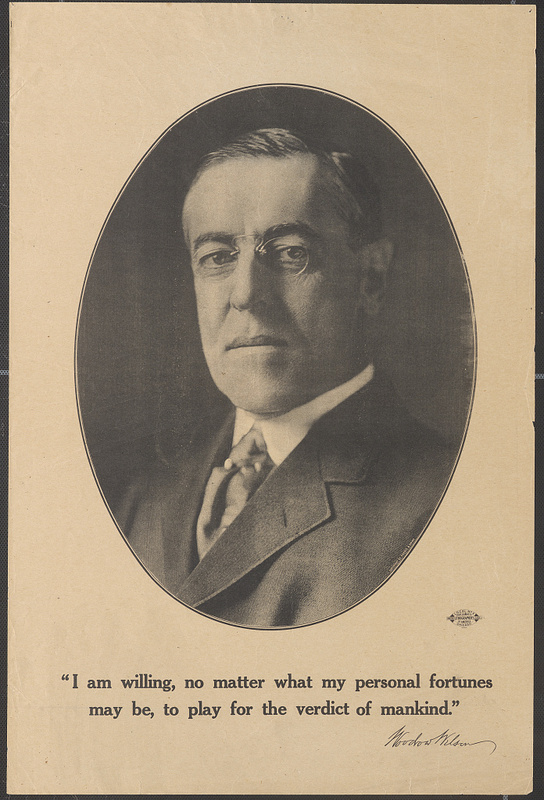
Wilson v Hughes
While the world was embroiled in the First World War, Americans went to the polls in 1916 to choose between President Woodrow Wilson and Republican challenger Charles Hughes1. Earlier in the year, at a contentious Republican convention, Hughes won the nomination despite former President Teddy Roosevelt’s attempts to reclaim the Republican mantle2. Following Roosevelt’s split with the Republicans in 1912 and running as a third-party candidate, old-guard Republicans refused to nominate him2. Hughes emerged as the most feasible candidate bridging the old-guard and Progressive Republican factions2.
Among the largest issues of the campaign were U.S. pacifism in the First World War and President Wilson’s policy towards Mexico3. Hughes, however, was not seen as a particularly powerful candidate2. Among his nicknames during the election was “Charles E-vasion Hughes”, as he often avoided criticizing Wilson’s first-term policies3.
Despite the weakness of Hughes’ perceived political stature, the election was decided by a mere 3,400 votes in California1.
California and Claims of Fraud
As early returns came in from around the nation, all signs pointed to a Hughes victory4. Newspapers like the Brown Daily Herald pre-emptively called the race for Hughes on election night. They led with the following headline: “Hughes Elected to Presidency; Republicans Carry Both Houses”.4 Other outlets around the country did the same, as the New York Times led with the premature outcome5.
By all accounts, Hughes went to bed on election night believing he was the incoming U.S. president5. However, as returns continued to come in the next morning, Wilson pulled ahead in California4. As votes continued to be counted in California, both campaigns claimed premature victory3. California was finally called for President Wilson on November 10th, three days after Election Day4.
Immediately after California was declared a Wilson victory, Republican campaign managers alleged voter fraud had occurred in the state6. Unlike parties of the past, the Republican National Committee did not spread these claims. As reported by the Freedonia Censor, Chairman Wilcox of the Republican Party stated:
“The national committee is not raising the cry of fraud nor is it going out searching for fraud. We have received any number of communications, signed and unsigned, by telegraph, letter, and by telephone alleging fraud from all parts of the country but in all cases the communications are referred back by us to state officials for investigation.”6
Republican nominee Charles E. Hughes led the charge against the claims7. While he waited two weeks for the official California returns before conceding, he dismissed all fraud allegations7. The New York Times reported on his stance:
“Mr. Hughes declared that in the absence of absolute of fraud no such cry should be raised to becloud the title of the next President of the United States.”7
In the end, Wilson was declared the winner, and the election results were not widely debated. Hughes’ selfless act in putting the legacy of the presidency above his self-interest remains notable in the history of contested elections.
References
-
Drexler, K. (n.d.). Research Guides: Presidential Election of 1916: A Resource Guide: Introduction. Guides.loc.gov. https://guides.loc.gov/presidential-election-1916 ↩ ↩2
-
Phelps, N. M. (2013). The Election of 1916. A Companion to Woodrow Wilson, 173-189. ↩ ↩2 ↩3 ↩4
-
Huston, J. A. (1964). The Election of 1916. Current History, 47(278), 205–242. http://www.jstor.org/stable/45311185 ↩ ↩2 ↩3
-
Pollard, B. (2020, October 30). 1916: The presidential election The Herald got wrong. The Brown Daily Herald. https://www.browndailyherald.com/article/2020/10/1916-the-presidential-election-the-herald-got-wrong ↩ ↩2 ↩3 ↩4
-
Bomboy, S. (2024, April 11). The remarkable career of Charles Evans Hughes - National Constitution Center. National Constitution Center – Constitutioncenter.org. https://constitutioncenter.org/blog/the-man-most-qualified-to-be-president-who-wasnt ↩ ↩2
-
(1916, November 15). The Freedonia Censor. Retrieved from NYS Historic Newspapers, https://www.nyshistoricnewspapers.org/?a=d&d=fredc19161115-01.1.2&e=-------en-20--1--txt-txIN---------- ↩ ↩2
-
(1916, November 11). Hughes Silences Hasty Fraud. New York Times. Retrieved from New York Times, https://timesmachine.nytimes.com/timesmachine/1916/11/11/100227592.pdf?pdf_redirect=true&ip=0 ↩ ↩2 ↩3