2016:
Trump v Clinton
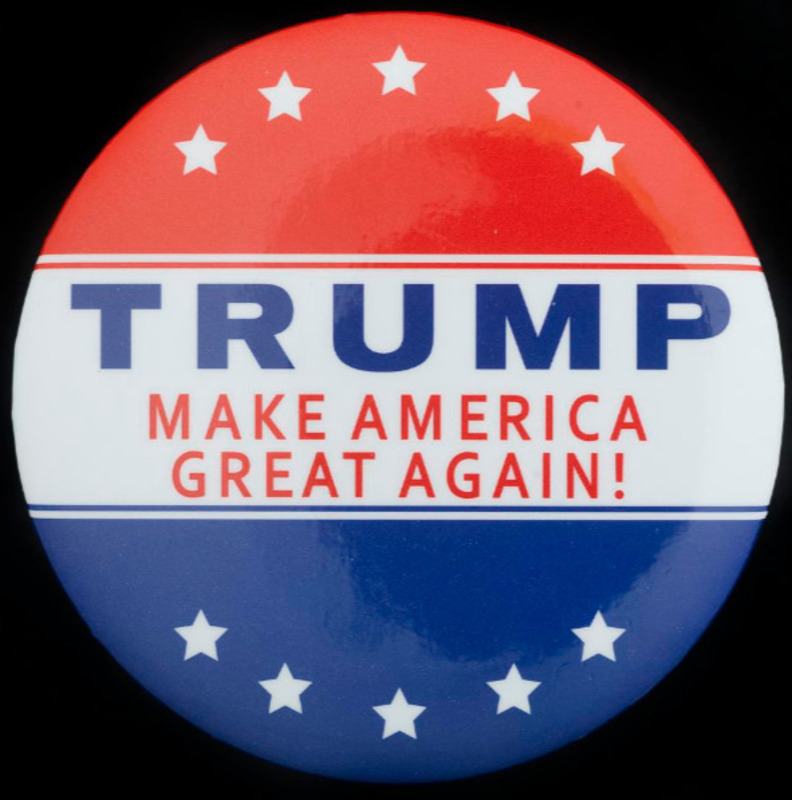
A Populist Moment
The lead-up to the 2016 election saw many candidates in both Democratic and Republican primaries utilizing populist rhetoric to gain support. Politicians like Bernie Sanders and Ted Cruz often played into these sentiments during the campaign1. However, none were as effective as Donald Trump, running as an outsider for the Republican nomination1. Trump framed his candidacy as a fight for working-class people, many of whom he claimed were left behind by the elites in media, politics, and education1. His strategy worked in the primary, as he became the Republican nominee in 2016.
On the other side, Bernie Sanders and Hillary Clinton battled one another in a heated Democratic primary2. In the contest, Sanders claimed that Clinton was on her way to securing the nomination because of a “rigged system”2. Sanders’ supporters also filed lawsuits against the Democratic National Committee, alleging that the DNC conspired against Sanders to help Clinton win2. Sanders, like Trump, used a message of representing the working class to go toe-to-toe with Clinton1. Despite the allegations of fraud and conspiracy, Clinton eventually won the nomination2.
Trump v Clinton
In the general election, immigration, economic policies, and foreign policy were the top issues separating the electorate3. Clinton and Trump’s differences on gun policy and healthcare also rounded out the main campaign topics3.
The vast majority of polling ahead of election day predicted a Clinton win4. Nearly all polls predicted that Trump would lose both the Electoral College and the popular vote4. However, voters would soon learn that polling is not always the most accurate predictor of electoral success.
On election night, November 8th, 2016, early returns had Clinton and Trump in tight contests in states like Virginia and Florida5. Reliable states in the South began to go for Trump, while northeastern states like Vermont were called for Clinton5. Later than expected, at 10 PM EST, Clinton finally won Virginia5. However, the trend of the night did not point to the easy electoral victory polling had predicted.
At 10:46, the first true swing state of the night, Ohio, was called for Trump5. Shortly after, both North Carolina and Florida also went in the Republican column5. The rest of the consequential swing states slowly went to Trump, and by 2:30 AM, Trump was declared the winner with 306 electoral votes compared to Clinton’s 2326. However, when the dust settled, Clinton had almost 3 million more votes than Trump, making her the 5th candidate in American history to win the popular vote and lose the election6.
Russian Election Interference
Following Trump’s electoral victory, widespread claims of election interference by the Russian government surfaced. These claims coincided with prior Russian actions taken during the 2016 Democratic Primary.
Three days before Hillary Clinton secured her party’s nomination at the Democratic Convention, over 44,000 emails from the Democratic National Committee were published on WikiLeaks2. The emails, stolen by Russian hackers, showed the Democratic Party’s top leadership favored Clinton in the race against Sanders2. Following the controversy, the DNC issued a formal apology to Sanders and DNC Chairwoman Debbie Wasserman Schultz was forced to resign2.
However, the leaks of DNC emails did not stop there. Shortly after the controversial Access Hollywood tape of Donald Trump was uncovered in October, the Russian government provided WikiLeaks with additional emails from DNC staff2. Later reports from the U.S. intelligence community alleged that Vladimir Putin and the Russians sought to harm Clinton’s election viability2. They also claim Putin engaged in the actions based on a clear preference for a Trump presidency7.
After Trump’s election, the FBI appointed former-director Robert Mueller to act as Special Counsel and investigate Russian election interference. In his final report, Mueller writes, “The Russian government interfered in the 2016 presidential election in sweeping and systemic fashion”8. In July 2016, the Trump Campaign’s Foreign Policy Advisor, George Papadopoulos, told a representative of a foreign government that:
”[T]he Trump Campaign had received indications from the Russian government that it could assist the Campaign through the anonymous release of information damaging to Democratic presidential candidate Hillary Clinton” 8.
Mueller said the work of the Russian government was twofold:
“First, a Russian entity carried out a social media campaign that favored presidential candidate Donald J. Trump and disparaged presidential candidate Hillary Clinton. Second, a Russian intelligence service conducted computer-intrusion operations against entities, employees, and volunteers working on the Clinton Campaign and then released stolen documents” 8.
Ultimately, the investigation led to indictments against individuals that were integral to Trump’s campaign and first term9. Among others, Trump’s former National Security Advisor, Michael Flynn, was indicted for providing false statements to the FBI concerning contacts with Russian officials9. The most glaring finding of the report, however, was the following line:
“Accordingly, while this report does not conclude that the President committed a crime, it also does not exonerate him.”8
References
-
Oliver, J. E., & Rahn, W. M. (2016). Rise of the “Trumpenvolk”: Populism in the 2016 Election. The Annals of the American Academy of Political and Social Science, 667, 189–206. http://www.jstor.org/stable/24756150 ↩ ↩2 ↩3 ↩4
-
Gaughan, A. J. (2019). Was the Democratic Nomination Rigged? A Reexamination of the Clinton-Sanders Presidential Race. SSRN Electronic Journal, 29(309). Available at: https://ssrn.com/abstract=3443916 ↩ ↩2 ↩3 ↩4 ↩5 ↩6 ↩7 ↩8 ↩9
-
Pew Research Center. (2016, July 7). Top voting issues in 2016 election. Pew Research Center - U.S. Politics & Policy. https://www.pewresearch.org/politics/2016/07/07/4-top-voting-issues-in-2016-election/ ↩ ↩2
-
Flanders, C. (2020). Was the 2016 Election Legitimate? Saint Louis University Law Journal, 64(4), 635–652. https://scholarship.law.slu.edu/lj/vol64/iss4/7 ↩ ↩2
-
New York Times. (2016, November 8). Election Night Live Coverage. The New York Times. https://www.nytimes.com/interactive/2016/11/08/us/elections/trump-clinton-election-night-live.html ↩ ↩2 ↩3 ↩4 ↩5
-
Federal Election Commission. (2017). Federal Elections 2016. https://www.fec.gov/resources/cms-content/documents/federalelections2016.pdf ↩ ↩2
-
Ziegler, C. E. (2017). International dimensions of electoral processes: Russia, the USA, and the 2016 elections. International Politics, 55(5), 557–574. https://doi.org/10.1057/s41311-017-0113-1 ↩
-
Mueller, R. S., & United States. Department of Justice. Special Counsel’s Office. (2019). Report on the investigation into Russian interference in the 2016 presidential election: submitted pursuant to 28 C.F.R. §600.8(c) ([Redacted version].). U.S. Department of Justice. https://permanent.fdlp.gov/gpo119472/report.pdf ↩ ↩2 ↩3 ↩4
-
ABC News. (2019, November 15). Here’s a breakdown of indictments and cases in Mueller’s probe. https://abcnews.go.com/Politics/breakdown-indictments-cases-muellers-probe/story?id=61219489 ↩ ↩2