1888:
Harrison v Cleveland
Electoral Corruption in the 1880s
Throughout the late 19th century, rampant election schemes plagued the nation. It was common that both parties engaged in both legal and illegal acts to ensure electoral victory1. First, normal campaigning and public persuasion methods were employed. Parties hoped to attract voters through messaging and public information campaigns1. However, other, more devious strategies were also at work. In the 1880s, vote-buying, “colonizing”, and repeat voting were all commonplace1.
With political polarization and party cohesion at high levels during the decade, the fight over independent voters became paramount to electoral success2. Republicans and Democrats engaged in efforts to buy these voters’ ballots and secure victory for their preferred candidate1. Called “floaters”, these voters sold their ballot to the highest bidder3. At the time, ballot boxes were often made of glass. Ballot secrecy was therefore nonexistent3. Thus, vote-buyers could be assured that paid voters did in fact cast a ballot for their party, making the scheme quite effective3.
Outside of vote-buying, parties also used the tactics of “colonization” and repeat voting to guarantee favorable election results1. “Colonization” referred to parties transporting non-residents into different states to cast illegal votes1. Often, voters would cast multiple ballots as well, in repeat voting schemes3.
Harrison v Cleveland

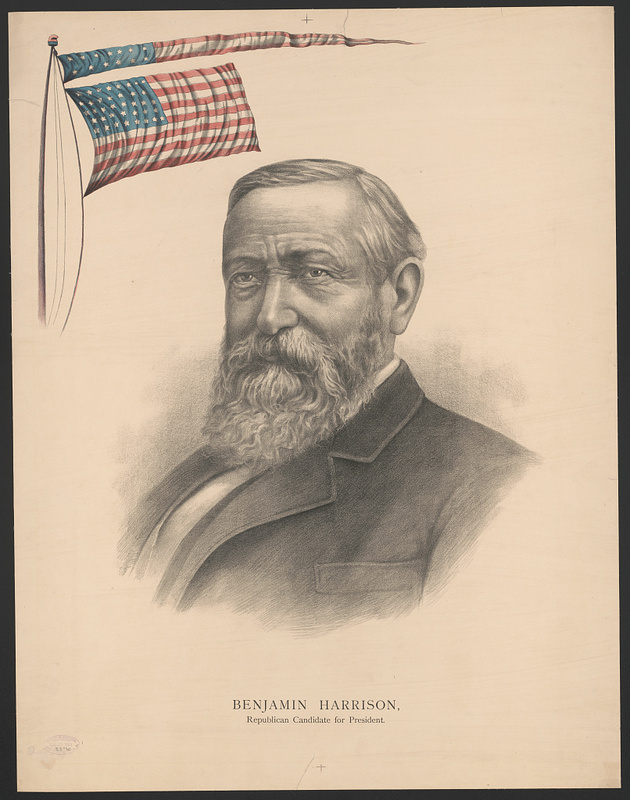
Tariffs represented the defining issue of the 1888 campaign4. Incumbent President Grover Cleveland ran as a tariff reformer, while Republican challenger Benjamin Harrison was a proponent of raising tariff rates3. With a stable national balance between the two parties, the election was gearing up to be decided by a narrow margin1.
However, in the electoral college, Republicans held a slight advantage1. The party could count on winning 182 of the required 201 votes to win the presidency1. In contrast, Democrats could only safely rely on 153 electoral votes. For both parties, the key to winning the contest came down to New York and Indiana1.
The Blocks of Five Scandal
While Harrison’s path to victory seemed less daunting than Cleveland’s, Cleveland had won both Indiana and New York in the prior 1884 election3. With less than a month to go until election day, Harrison’s campaign looked to be in trouble in the two states5. One of Harrison’s top campaign staffers and Treasurer of the Republican National Committee, W.W. Dudley, sought to change the increasingly bleak outcome5. He wrote instructions to top GOP officials in Indiana on October 24th, 1888:
“Divide the floaters into blocks of five and put a trusted man with necessary funds in charge of these five, and make him responsible that none get away and that all vote our ticket. There will be no doubt of your receiving the necessary funds…Only see that it is husbanded and made to produce results.”6
However, Democrats were made aware of the letter’s contents and informed a variety of newspapers5. Despite the newfound press coverage, Dudley’s utilization of vote-buying schemes in prior elections was already widely known, earning him the moniker “Two-Dollar Dudley”2. Nevertheless, the scandal consumed the Harrison campaign. However, it did not change the campaign’s tactics. Despite the public’s awareness of their illicit strategy, Republicans still engaged in vote-buying schemes in Indiana and across the nation3.
A Stolen Election?
After the ballots were tallied, Cleveland won almost 90,000 more individual votes than Harrison. However, with wins in both New York and Indiana, Harrison won the presidency. Harrison finished with 233 electoral votes compared to Cleveland’s 168.
The election remains one of the most blatantly corrupt in U.S. history. Widespread evidence (outside of Dudley’s letter) exists of vote-buying schemes taking place, along with voter “colonization”, and repeat voting1. For instance, in Bloomington, IN, almost 200 of the city’s 700 eligible voters were floaters and received payment for their votes1. In New York, the Republican Party was alleged to have sent over $150,000 to the leaders of Democratic voting groups, in exchange for up to 40,000 votes1. Harrison ended up winning New York with a mere 14,000-vote margin1. Numerous claims of fraud and corruption were made by both parties in the election2.
The outrage over election integrity in 1888 sparked widespread reforms across the nation. By the early 1890s, most states had adopted the Australian secrecy ballot7. Instead of casting votes in a public square, voters moved indoors to private voting booths, ensuring anonymity and confidence in results7.
References
-
Baumgardner, J. L. (1984). The 1888 Presidential Election: How Corrupt? Presidential Studies Quarterly, 14(3), 416–427. http://www.jstor.org/stable/27550102 ↩ ↩2 ↩3 ↩4 ↩5 ↩6 ↩7 ↩8 ↩9 ↩10 ↩11 ↩12 ↩13 ↩14
-
Summers, M. W. (2001). Party Games: The Art of Stealing Elections in the Late-Nineteenth-Century United States. The Journal of American History, 88(2), 424–435. https://doi.org/10.2307/2675098 ↩ ↩2 ↩3
-
Ackerman, S. J. (1998, November). The Vote That Failed. Smithsonian Magazine. https://www.smithsonianmag.com/history/the-vote-that-failed-159427766/ ↩ ↩2 ↩3 ↩4 ↩5 ↩6 ↩7
-
Weston, T. (n.d.). Research Guides: 1888 Presidential Election of Benjamin Harrison: Topics in Chronicling America: Introduction. Guides.loc.gov. https://guides.loc.gov/chronicling-america-1888-presidential-election ↩
-
Fischer, R. A. (1991). “Blocks of Five” Dudley, Cartoon Celebrity. Indiana Magazine of History, 87(4), 334–347. http://www.jstor.org/stable/27791507 ↩ ↩2 ↩3
-
(1888, November 1). St. Paul Daily Globe. Retrieved from the Library of Congress, https://www.loc.gov/item/sn90059522/1888-11-01/ed-1/. ↩
-
Wasley, P. (2016). Back When Everyone Knew How You Voted. The National Endowment for the Humanities. https://www.neh.gov/humanities/2016/fall/feature/back-when-everyone-knew-how-you-voted ↩ ↩2