2000:
Bush v Gore
The Primaries
In the 2000 Republican primary election, Governor George W. Bush of Texas, son of former President George H.W. Bush, ran as the front-runner. He fought off John McCain for the nomination and selected former Secretary of Defense Dick Cheney as his V.P. candidate. On the Democratic side, then Vice President Al Gore easily won the nomination and selected Joe Lieberman as his choice for V.P.
Bush v Gore
The main issues in the election revolved around economic policy, such as taxes and social welfare spending. Additionally, after President Clinton’s sex scandal, Bush and the Republican Party hit Democrats on the issue of morality and presidential values1. Gore was forced to campaign away from Clinton and their record in office, instead emphasizing the future2. Throughout the election cycle, Democrats emphasized government solutions to policy failures while Republicans focused on free-market and private alternatives2. Nonetheless, polling showed Bush and Gore tied heading into election day3.
On November 7th, 2000, voters went to the polls and eagerly awaited the results. As returns began coming in, projections from CBS News and other media outlets predicted a Gore victory3. While Bush carried most of the South, and the northeastern states went to Gore, Florida was initially put into Gore’s column early in the night3. At 7:50 p.m. EST, Gore was declared the next president4. However, Bush waited for the results to continue coming in before calling Gore and conceding3. He made the right choice, as within two hours of Florida being called for Gore, networks retracted the prediction at 10 p.m. EST4.
Around 2 a.m. EST media outlets projected that Bush would carry Florida and win the election3. Shortly after, Gore called Bush to concede the contest3. However, once again, the networks were forced to retract their Florida prediction. Gore phoned Bush a second time to withdraw his previous concession2. Neither candidate knew then, but the election would drag on for the next 36 days.
Lawsuits, Recounts, and Hanging Chads
The next day, on November 8th, the state of Florida ordered a recount due to the vote margin between the candidates falling within 0.5% 4. At the time, Bush led Gore by only 1,800 votes3. After a quick statewide recount via machine, Bush’s lead shrank to 229 votes3. However, before Florida could certify the results, the Gore campaign requested hand recounts in four counties5. In response, on November 11th, the Bush campaign sued to stop the hand recounts, litigation that failed in district court5.
Over the next few weeks, the Bush and Gore campaigns filed numerous lawsuits regarding the hand recounts in the four Florida counties6. As the recounts proceeded, a variety of issues with Florida ballots were made clear.
First, in Palm Beach County, “butterfly” ballots were used in the election7. These ballots were confusing to voters, as they listed candidates on both the left and right sides of the pages. The voter had to fill in the corresponding bubble for their preferred candidate, but the bubbles were tightly formatted in the middle of the two sides of the page7. Some voters mistakenly voted for Pat Buchanan instead of Gore, as the bubbles were placed close together7.
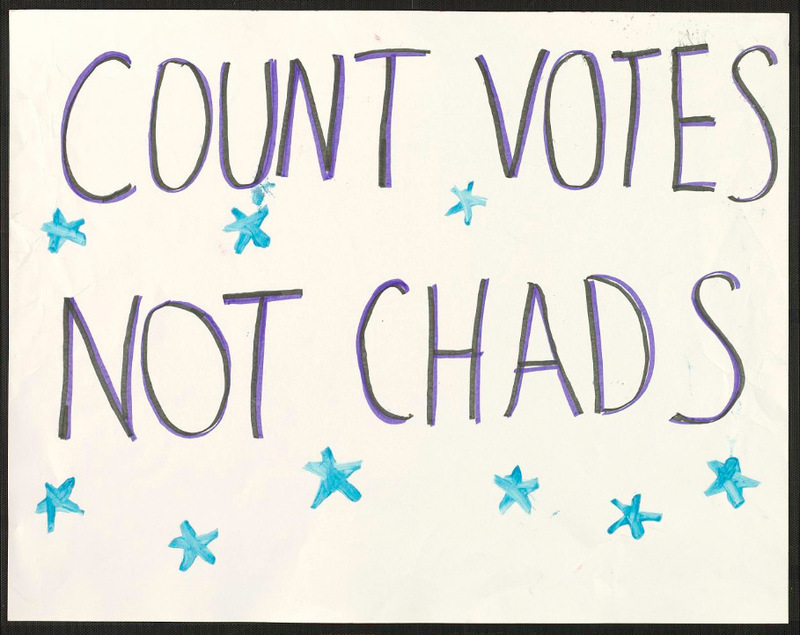
Additionally, other counties used punch-card ballots for voting7. To vote using this method, citizens punched a hole (also called a chad hole) in the bubble next to their preferred candidate8. The ballots were a large issue in 2000, as many voters did not fully punch a hole in the ballot and instead left a “hanging chad”[^8.] Courts and canvassing boards were unsure of how to count these ballots. Other voters in these counties left “dimpled chads”, where an indentation in the ballot was the only form of marking on the paper ballot8. The main concern with the chads was that machines counted the votes by shining light through the holes on the ballot. If a hanging chad was left on the ballot, it could prevent the light from getting through the paper, and thus not count the vote8.
The Gore campaign successfully sued for counties to include these types of chads in the hand recounts3. However, the first deadline for certifying the votes was November 18th, and many counties were not close to finishing their recounts. The Gore campaign again successfully sued to extend the deadline to November 25th 3. When the 25th came, Florida Secretary of State Katherine Harris chose not to include the recounted ballots (as the recounts were still not complete), and certified Bush as the winner with a 537-vote lead3.
Gore immediately sued Harris and the state over the result5. His lawyers requested that the Florida Supreme Court order a recount of 14,000 disputed ballots by hand5. While the court rejected these arguments, on December 8th, they ordered a recount in some counties of “undervotes” (dimpled chads)7.
Meanwhile, the U.S. Supreme Court had agreed to review two of the cases in Florida following appeals by the Bush campaign. First, on December 9th, by a 7-2 vote, they ruled that Florida must pause the recounts immediately6. The court agreed with the Bush lawyers that a recount would cause “irreparable harm” to Bush and undermine the legitimacy of the election3. Finally, on December 12th, the justices reversed the Florida Supreme Court decision by a 5-4 margin6. Due to the lack of uniformity regarding recount practices in the state and the time required to implement new standards, the court upheld Harris’ certification of the 537-vote lead for Bush in Florida6.
Gore officially conceded the race to Bush on December 13th. After five weeks of litigation, Bush won the presidency. Bush became the fourth president to win the Electoral College and lose the popular vote. He won 271 electoral votes compared to Gore’s 267 votes, with a 500,000-vote lead for Gore overall9.
References
-
Pomper, G. M. (2001). The 2000 Presidential Election: Why Gore Lost. Political Science Quarterly, 116(2), 201–223. https://doi.org/10.2307/798059 ↩
-
Mann, T. E. (2001, January 1). Reflections on the 2000 U.S. Presidential Election. Brookings; Brookings. https://www.brookings.edu/articles/reflections-on-the-2000-u-s-presidential-election/ ↩ ↩2 ↩3
-
Gormly, J. (2012). Hanging by a Chad—or Not: The 2000 Presidential Election | Gilder Lehrman Institute of American History. www.gilderlehrman.org. https://www.gilderlehrman.org/history-resources/essays/hanging-chad-or-not-2000-presidential-election ↩ ↩2 ↩3 ↩4 ↩5 ↩6 ↩7 ↩8 ↩9 ↩10 ↩11 ↩12
-
CSPAN. (2020). A Timeline of Events in the 2000 Presidential Election | C-SPAN Classroom. https://www.c-span.org/classroom/document/?17389 ↩ ↩2 ↩3
-
Rothenberg, K. (n.d.). LibGuides: Election 2000: Timeline. Guides.law.stanford.edu. https://guides.law.stanford.edu/c.php?g=991108&p=7170216 ↩ ↩2 ↩3 ↩4
-
Elving, R. (2018, November 12). The Florida Recount Of 2000: A Nightmare That Goes On Haunting. NPR.org. https://www.npr.org/2018/11/12/666812854/the-florida-recount-of-2000-a-nightmare-that-goes-on-haunting ↩ ↩2 ↩3 ↩4
-
Agresti, A., & Presnell, B. (2002). Misvotes, Undervotes and Overvotes: The 2000 Presidential Election in Florida. Statistical Science, 17(4), 436–440. http://www.jstor.org/stable/3182765 ↩ ↩2 ↩3 ↩4 ↩5
-
Posner, R. A. (2001). Breaking the deadlock : the 2000 election, the constitution, and the courts (Core Textbook). Princeton University Press. https://doi.org/10.1515/9781400824281 ↩ ↩2 ↩3
-
Woolley, J., & Peters, G. (2000). 2000 | The American Presidency Project. www.presidency.ucsb.edu. https://www.presidency.ucsb.edu/statistics/elections/2000 ↩